
12 Beginner Mistakes That Stop You From Making Money Online (And How to Fix Them)

These 12 mistakes that stop you from making money online are more specific than you think. This honest guide names each one clearly, explains why it costs you, and gives you an exact fix for each.

Most people who struggle to make money online are not lazy.
They’re actually working hard. Posting content, reading guides, watching tutorials, signing up for platforms, starting and restarting. The effort is real. The income just isn’t arriving to match it.
And when that happens long enough, the natural conclusion is that the methods don’t work, or that online income is only for people with some specific advantage they don’t have.
That conclusion is almost always wrong.
The mistakes that stop you from making money online are not obvious from the inside. They feel like normal, reasonable decisions. That is exactly what makes them so costly. You are not failing because you are doing something clearly wrong. You are failing because you are doing something subtly wrong, repeatedly, in a way that compounds over time.
This guide names all twelve of them specifically, explains what each one costs you, and tells you exactly how to fix it.
Quick Answer
The most common mistakes that stop beginners from making money online include starting without a clear niche, jumping between methods before any of them have time to produce results, consuming content without applying it, ignoring the email list until it’s “time,” and quitting during the slow middle phase that every legitimate income method goes through before it gains momentum. Most of these mistakes are fixable within days of identifying them.
TL;DR
- Most beginner online income failures are not method failures. They are execution failures caused by specific, identifiable, fixable patterns.
- The majority of mistakes on this list involve either quitting too early, starting too scattered, or skipping foundational infrastructure in favor of visible activities.
- Fixing even three or four of these mistakes immediately changes the trajectory of your online income without switching to a new method.
- The pattern underneath almost all twelve is the same: expecting short-term results from a long-term game.

Most Beginner Mistakes Start With a Lack of Direction
The biggest mistakes usually happen when people are forced to guess their way forward. A clear plan removes a lot of those wrong turns. The First Dollar Blueprint gives you one specific action per day for seven days, helping you focus on what matters instead of wasting time on the mistakes that slow most beginners down.
12 Beginner Mistakes That Stop You From Making Money Online: A Quick Summary
| Mistake | What It Costs You | How to Fix It |
|---|---|---|
| 1. Waiting until you feel ready | Months of lost progress while “preparing” | Set a start date within 7 days. Start before you feel ready. |
| 2. Learning instead of doing | Knowledge without application that produces no income | Apply one lesson before consuming the next piece of content. |
| 3. Copying what successful people do now | Trying to run before you can walk | Study their earliest content, not their current output. |
| 4. Building without an email list | Losing readers forever when platforms change | Create a Beehiiv account today and add the signup link everywhere. |
| 5. Trying to talk to everyone | Content that resonates with no one | Write for one specific person. One reader. One situation. |
| 6. Treating every bad week as proof the method fails | Quitting before any method has time to work | Assign a minimum evaluation window (6 months for content, 8 weeks for services). |
| 7. Setting up accounts on every platform | Six mediocre presences instead of one strong one | Pick one platform. Commit to it for 90 days. Add more later. |
| 8. Writing for search engines instead of people | Content that ranks poorly and earns nothing | Write for a real person first. Add keyword research afterward. |
| 9. Watching income reports as roadmaps | Unrealistic expectations that lead to quitting | Find early content from the same creator. Read that alongside the report. |
| 10. Skipping the boring foundation work | Content that exists but never gets found | Run a pre-publish checklist: keywords, meta, internal links, Search Console, email capture. |
| 11. Selling before you’ve given | Lost trust and zero conversions | Give ten times before you ask once. Build the trust account first. |
| 12. Quitting right before momentum kicks in | Missing the moment the curve steepens | Set a 12-month minimum commitment before evaluating anything. |
The Pattern Underneath All 12 Mistakes
| If You’re Making This Mistake… | The Real Issue Is… |
|---|---|
| Waiting, learning, copying current content | Confusing preparation with progress |
| No email list, multiple platforms, selling too early | Building on borrowed land instead of your own |
| Talking to everyone, bad weeks feel like failure | Wrong expectations about timelines |
| Writing for algorithms, skipping foundation | Prioritizing visible work over important work |
| Quitting before momentum hits | Expecting short-term results from a long-term game |
Beginner Mistakes That Stop You From Making Money Online
If you’re struggling to earn your first dollar online, the problem may not be the method you’ve chosen. In many cases, a few common beginner mistakes are what stand between effort and results. Let’s break them down one by one.
Mistake 1: Waiting Until You Feel Ready
This is the most common and most costly mistake on the entire list, and it is the one that feels the most justified while it is happening.
Beginners tell themselves they need to learn more about SEO before they start the blog. They need to understand affiliate marketing more deeply before they apply to programs. They need to improve their writing, do more research, find the perfect niche, set up the perfect profile.
All of that sounds like preparation. Most of it is avoidance.
Here is the specific thing I discovered about online income that took me longer to understand than it should have. Readiness does not come before starting. It comes because of starting. The information that actually changes your skill level is the information you encounter while doing real work for a real audience, not the information you consume while preparing to do real work.
I spent six weeks learning everything I could about blogging before I published my first post. In the seven days after publishing that first post, I learned more about what actually matters in this space than I had in the entire six weeks before it. Real feedback from a real audience is not the same as theory from a tutorial.
How to fix this: Set a start date no more than seven days from now. Not a launch date. A start date. The date you publish the first piece of content, create the first gig, or send the first pitch. Whatever is not done by that date gets done after you’ve started, not before.
Check out: How to Start Earning Online in 7 Days: A Step-by-Step Guide for Beginners
Mistake 2: Learning Instead of Doing
This mistake is closely related to the first one but distinct enough to deserve its own entry, because it catches a different type of person.
Some beginners are not waiting to start because they’re afraid. They are waiting because learning genuinely feels productive to them. Watching another tutorial, reading another guide, following another creator who explains the strategy clearly. The feeling of understanding accumulates and gets mistaken for progress.
I have felt this personally. There was a period where I could explain affiliate marketing, content strategy, and email list building with real fluency at a dinner table conversation, while producing almost nothing. The knowledge was real. The income was zero.
Knowledge without application is preparation that never ends. Every answer you find through research generates three more questions, which sends you back into learning mode before you have produced anything that could provide actual answers through actual feedback.
How to fix this: Implement the last thing you learned before you consume the next piece of content. One article read. One action taken. No new content until the previous lesson has been applied. This single constraint, enforced ruthlessly, moves more people from stuck to earning than almost any other change I have seen.
See also: Things I Wish I Knew Before Trying to Make Money Online
Mistake 3: Copying What Successful People Do Now Instead of What They Did First
This one is subtle, and I want to explain it carefully because it catches a lot of thoughtful, observant beginners.
When you study a successful online creator or blogger, you naturally look at what they are doing currently. The type of content they publish now. The platforms they are active on now. The products they promote now. The frequency they post at now.
And you try to replicate that.
The problem is that what successful people are doing now is a reflection of where they are in year three or year five of building, not where they were in month one. They are maintaining and scaling an established presence. You are trying to build one from scratch.
A creator who now posts three times per week on YouTube, runs a weekly newsletter, manages an Instagram account, and sells a course can do all of that because the first two years of building created systems, team members, and processes that a beginner trying to replicate their current output on day one will never be able to sustain.
Following the current output of a successful creator instead of their early output is like trying to run a marathon by watching someone in mile twenty-three and copying their pace.
How to fix this: When you study a creator you admire, go backwards. Find their oldest content. What were they doing in month one? Month three? What did their output look like before they had an audience? That is the version of their strategy you can actually learn from and apply to your own beginning.
Mistake 4: Building Without an Email List
Not starting an email list from day one is one of the most common mistakes that stop you from making money online, and the cost of this mistake is not visible until much later, which is exactly what makes it so damaging.
When you post social media content, the platform decides how many of your followers see it. When you publish a blog post, Google decides whether it ranks. When you upload a YouTube video, the algorithm decides who it reaches. You are building on land that belongs to someone else, and the rules of that land change without your input.
An email list is different. When someone gives you their email address, you have a direct, unmediated connection to them that no platform can restrict. You send an email, and it lands in their inbox. No algorithm between you and the reader. No reach limitation from a policy change you had no say in.
I watched this play out with creators I knew when a social platform changed its algorithm, and organic reach dropped dramatically overnight. The ones with large email lists lost almost no effective audience reach. The ones without them lost years of built audience in a single update.
How to actually fix this: Create a free account on Beehiiv today, before your next piece of content goes anywhere. Your Beehiiv page gives you a live subscriber signup URL the moment the account is created. Add that link to your bio, your content, and every platform you use. The list that saves you years of vulnerability starts with one subscriber.
See also: How to Start Building an Email List
Mistake 5: Trying to Talk to Everyone
When beginners are unsure what their audience looks like, they try to write for everyone. The result is content that resonates with no one.
Content written for everyone is content that uses language general enough to apply broadly, covers topics popular enough to attract a large audience, and gives advice safe enough not to alienate anyone. That combination describes the most forgettable content on the internet.
The people who make money online consistently are the ones who have chosen a specific person they are talking to and write every piece of content as if that specific person is reading it. Not a demographic. A person. A 32-year-old parent who wants to earn an extra $500 per month from their phone during naptime. A recent graduate who wants to build a freelancing career with no work experience. A stay-at-home parent who knows they have a skill but doesn’t know how to package it.
When you know exactly who you are writing for, the language you use, the examples you choose, the products you recommend, and the problems you address all become specific enough to feel like the reader’s situation was written about personally. That specificity is what builds the trust that converts readers into buyers.
The Fix: Write a single paragraph describing your specific reader. Not a general audience. One specific type of person, with specific circumstances, specific frustrations, and a specific outcome they are working toward. Read that paragraph before you create any piece of content. Write to that person.
Mistake 6: Treating Every Bad Week as Evidence the Method Doesn’t Work
This is one of the most specific patterns in beginner online income failure, and I want to be direct about what it actually looks like.
A beginner starts a blog. In week one and two they publish two articles each week. In week three, traffic is still near zero. They start to wonder if SEO is dead or if blogging actually works anymore.
A beginner launches a Fiverr gig. In the first ten days they get two profile views and no messages. They start to wonder if Fiverr is oversaturated or if their niche is too competitive.
Both of these conclusions are drawn from a timeline that is simply too short to contain meaningful data.
A blog that has been publishing for three weeks has not been indexed long enough, built enough internal links, or accumulated enough topical authority for Google to know what it is about. The absence of traffic in week three is not information about whether blogging works. It is information about what three weeks of anything looks like.
Here is the specific timeline reality across the most common beginner methods. A blog needs six to twelve months of consistent publishing before search traffic becomes meaningful. A Fiverr gig needs four to six weeks of active promotion before orders come in reliably. An affiliate newsletter needs three to six months of consistent issues before the list is warm enough to convert on recommendations.
How to fix this: Assign a minimum evaluation window to whatever method you choose before you draw any conclusions about whether it works. For content-based methods, that minimum is six months. For service-based methods, it is eight weeks. Any conclusion drawn before those windows is not data. It is impatience wearing the costume of analysis.
Mistake 7: Setting Up Accounts on Every Platform at Once
I have described this mistake in my other article as “the illusion of progress,” and I think that phrase captures it accurately.
Setting up a Fiverr profile, an Upwork account, a TikTok page, a Pinterest business account, a Twitter for business, and a LinkedIn professional profile in the same week feels like building an online business. It involves real actions, real form completion, and real time.
What it does not produce is a competitive presence on any of those platforms.
Every platform rewards consistency, history, and active engagement over time. A new account on any platform is at its least competitive at the moment of creation. The path to visibility and income on any of these platforms requires months of consistent activity that signals to the platform that you are a real, engaged user worth showing to others.
Spreading that time across six platforms simultaneously means each platform gets roughly one-sixth of the consistent activity it needs to develop that history. You end up with six mediocre presences rather than one strong one.
The Fix: Pick one platform based on where your specific audience spends the most time and where the content format matches your natural strengths. Commit to that platform exclusively for 90 days. After 90 days, if it is producing results, continue. If it is not, make one change based on what you learned and continue for another 90 days before adding a second platform.
Mistake 8: Writing for Search Engines Instead of Real People
This mistake has been killing beginner blogs and content sites for years, and what makes it particularly painful is that it feels like the smart, strategic approach when you are doing it.
Here is what it looks like. A beginner learns that their article should include the keyword “best email marketing tools for beginners” multiple times. They include it in the first paragraph, two or three subheadings, and several times throughout the body. The article is structured around keyword placement rather than around what someone searching that phrase actually wants to find.
The result is an article that reads like it was written to pass a software test rather than to actually help a confused beginner choose an email marketing tool. It is technically keyword-correct and practically hollow.
Google’s Helpful Content updates have moved the search algorithm significantly toward rewarding content that demonstrates genuine expertise and satisfies the reader’s actual intent, not content that places keywords in the right containers.
The practical cost of this mistake is significant. Articles written primarily for search engines earn worse rankings than articles written for real people that also include relevant keywords naturally. The old formula of keyword density and placement signals no longer outperforms genuine helpfulness. This is a meaningful shift that many beginner guides have not yet updated to reflect.
The Fix: Write the article first as if you are explaining the topic to a specific friend who needs help with it. Make it genuinely useful. Add the keyword research layer afterward, verifying that you have covered the specific questions and subtopics your audience is actually searching for. Semrush shows you the related questions and subtopics that belong in a comprehensive treatment of any topic, which tells you what to include rather than just which phrases to place.
Mistake 9: Watching Income Reports and Treating Them as a Roadmap
Income reports from successful bloggers and online creators can be genuinely useful. They can also be one of the most misleading things a beginner consumes, depending on how they are interpreted.
The specific problem is this. An income report shows you the revenue of an established content business with an existing audience, an existing content library, and existing domain authority. It does not show you the 22 months of minimal earnings that came before the month being reported. It does not show you the failed experiments, the abandoned niches, or the pieces of content that never ranked.
What it shows you is a snapshot of success pulled out of a timeline that would change everything about how inspiring that snapshot feels.
When a beginner reads a $14,000 month income report from a personal finance blogger, sees that most of it came from affiliate commissions on email marketing tools, and then tries to build the same model, they encounter something the income report did not prepare them for.
The commissions in that report came from an email list of 25,000 people built over four years and content that has been ranking and compounding for three. The method is exactly right. The timeline is not what the report suggests.
The Fix: When you read an income report, find the corresponding content the creator published in their first year. Read that alongside the income report. What did their traffic look like in month six? What did their income look like in month three? The realistic picture of what you are building toward is in those early posts, not in the success snapshot.
Mistake 10: Skipping the Foundation Because It Feels Boring
The unglamorous infrastructure of online income building is the part most beginners skip, and it is also the part most responsible for the difference between content that earns and content that simply exists.
Proper keyword research before writing an article. Setting up Google Search Console to understand how the site is being indexed. Installing an SEO plugin and properly completing meta descriptions and title tags. Setting up an email capture form and a welcome sequence before publishing the first piece of content. Registering a real domain rather than using a free subdomain.
None of these feel as exciting as writing content or creating social media posts. All of them are more important to long-term income than the content itself, because content without the infrastructure to distribute it is like a great product in a store with no signage, no address, and no open sign.
I learned this specifically when I looked at two pieces of content I had written with similar quality, on similar topics, at similar times. One had a properly researched keyword, a complete meta description, and internal links to related content. The other did not. Twelve months later, the first was generating steady monthly traffic. The second had attracted almost nothing.
How to fix this: Before you publish anything, run a brief infrastructure checklist. Is the keyword researched? Is the meta description written? Are there internal links to related content? Is the site connected to Google Search Console? Is there a way for readers to join your email list from this page? If not, fix those things before you hit publish. Hostinger makes getting the technical foundation right from the beginning genuinely manageable, even for someone with no web development background.
Mistake 11: Selling Before You’ve Given
This is a mistake that beginner affiliate marketers and digital product sellers make more than any other group, and it costs them both income and audience trust at the same time.
The pattern looks like this. Someone joins an affiliate program, gets their links, and immediately starts sharing them in social media posts, Facebook groups, and emails to whoever they can reach. The content around the link is minimal. “Check out this tool, it helped me a lot.” The person sharing the link has used the tool for a week. The audience has no context for why they should trust the recommendation.
No one buys.
The conclusion drawn is that affiliate marketing doesn’t work. The actual conclusion should be that promotion without established trust doesn’t work, which is not a statement about affiliate marketing. It is a statement about human psychology.
People buy from sources they trust. Trust is built through consistent, genuine helpfulness over time. A blogger who has published 40 articles helping their readers solve specific problems without asking for anything has built the kind of credibility that makes their 41st article, which includes an affiliate recommendation, convert at a meaningful rate.
The sequence is: give first, give again, give again, earn the right to recommend, then recommend.
The Fix: Before you promote anything, count how many times you have genuinely helped your audience with no ask attached. If the honest answer is fewer than ten, your first ten pieces of content should contain nothing promotional. Build the trust account before you make a withdrawal from it.
For a clear system on how affiliate recommendations should be structured within helpful content, The H.E.A.R.T Funnel Formula maps the exact sequence that makes recommendations convert without feeling like a sales pitch.
See also: How to Earn Extra Income Online with Affiliate Marketing

People Rarely Buy Because of a Link Alone
Most affiliate sales happen because the recommendation makes sense within the content, not because someone dropped a link into a paragraph. The H.E.A.R.T Funnel Formula shows you how to structure content, build trust, and present recommendations in a way that feels helpful to readers while still driving commissions.
Mistake 12: Quitting Right Before Momentum Kicks In
This is the mistake that costs people the most, and the one that is hardest to identify while it is happening, because from the inside it does not feel like quitting. It feels like a rational response to a situation that has not produced results.
Here is a specific and honest way to understand compounding in online income building.
A content site in month two looks almost exactly like it did in month one. A small number of articles, minimal traffic, no meaningful income. A content site in month four looks slightly better. More articles, slightly more traffic, still minimal income. A content site in month seven starts to look genuinely different. Earlier articles have accumulated backlinks, built internal link equity, and reached page positions that bring consistent organic traffic. New articles rank faster because the domain has established authority.
The graph of growth in this model is not a straight line. It is a curve that is nearly flat for months and then begins to steepen. Most people quit during the flat section, often within sight of where the curve would have started to rise.
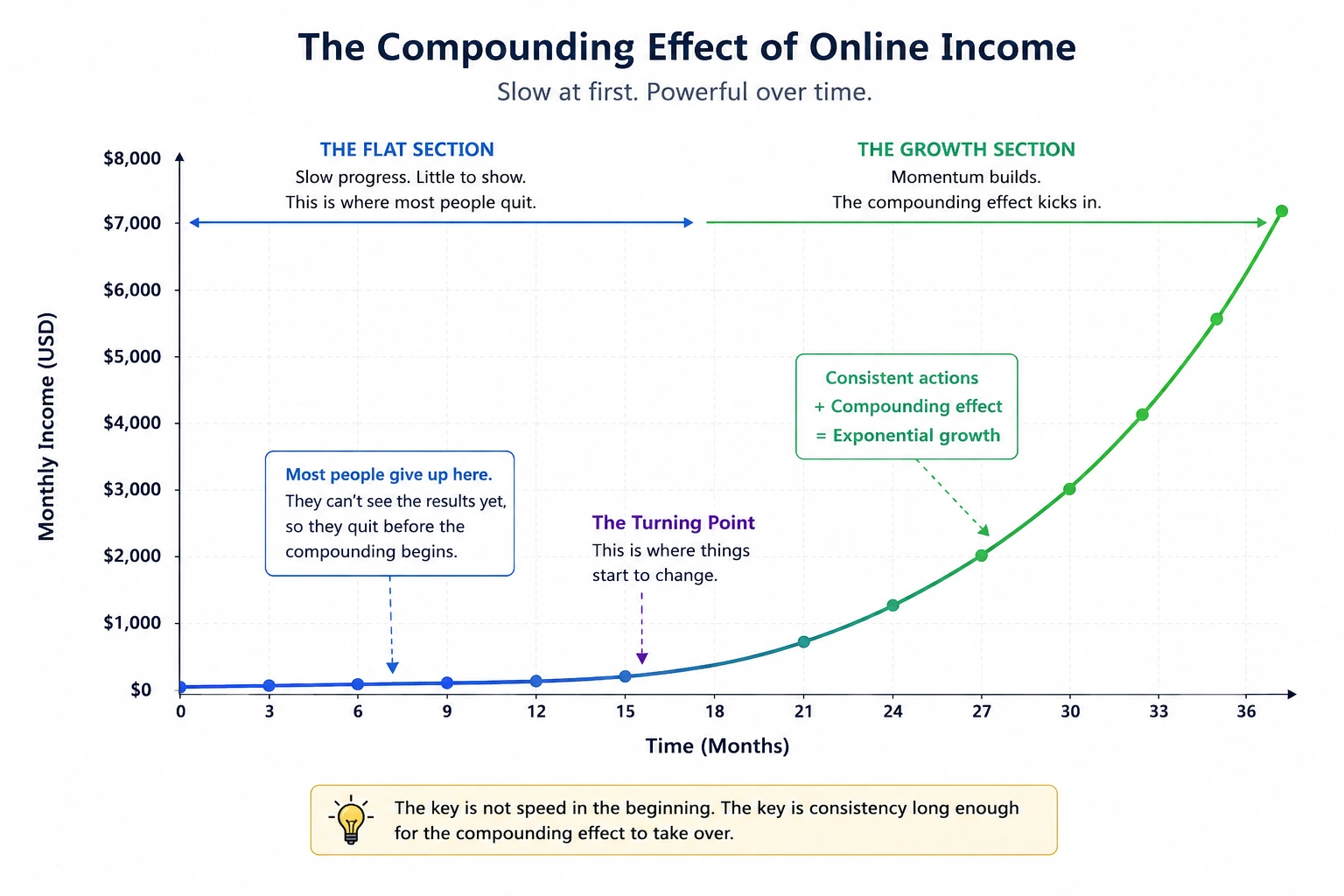
I have no way to tell you exactly when your specific curve steepens. That depends on your niche, your content quality, your keyword targeting, and a dozen other factors. What I can tell you with confidence is that the people talking about their income results in this space now are almost universally those who went through a flat section lasting between six and eighteen months before the curve changed.
How to fix this: Set a minimum commitment before you evaluate anything. Twelve months of consistent effort in a content-based model. Eight weeks of consistent pitching in a service-based model. Decide right now, before motivation gets hard, that you will not evaluate whether to continue until that minimum has been reached. Decisions made at month three from inside the flat section of the curve are almost never as accurate as decisions made at month nine from a position where you have actual data.
See also: Why Beginners Fail at Making Money Online
Key Takeaways
The mistakes that stop you from making money online are almost never about choosing the wrong method. They are about how the chosen method is applied over time, specifically whether enough time and consistent effort is applied for the method to demonstrate what it can actually do.
Fixing these mistakes does not require starting over. Most of them can be addressed immediately without abandoning what you have already built. Starting the email list today. Narrowing your content focus this week. Setting a minimum evaluation window before the next strategic shift.
The pattern underneath most of the twelve mistakes is the same. Expecting short-term results from a long-term game. Every legitimate online income method has a compounding phase that looks discouraging before it looks promising. The distinguishing factor between success and failure in this space is nearly always who stays through that phase.
Boring infrastructure beats exciting content without it. Keyword research, email capture, meta descriptions, and proper site setup are less exciting than publishing content, but they are what determine whether content finds its audience or disappears into the void.
Conclusion
The mistakes that stop you from making money online are not dramatic failures. They are quiet, repeating patterns that feel like reasonable decisions until you see them named clearly from the outside.
Waiting until you feel ready. Learning instead of doing. Copying the wrong stage of someone else’s journey. Building without an email list. Talking to everyone and connecting with no one. Evaluating too early. Spreading too thin. Writing for robots instead of people. Treating income reports as instruction manuals. Skipping the boring foundation. Selling before giving. Quitting in the flat section of a curve that was about to rise.
Every one of these is fixable. Not all at once. But even fixing three or four of them this week changes the trajectory of everything you are building.
Go back through this list and identify the two or three mistakes that describe your current situation most accurately. Focus on those first. Build the habit of fixing them before you move to anything new.
The income you have been working toward is not behind a different method. It is behind the consistent application of the method you have already chosen, with the specific mistakes corrected.
The First Dollar Blueprint gives you the structured first seven days of that corrected approach, one task per day, built for someone who is ready to apply rather than continue preparing.
Frequently Asked Questions
What are the most common mistakes that stop beginners from making money online?
The most common mistakes that stop beginners from making money online fall into three broad patterns: starting without the right infrastructure, like no email list and no keyword research process; applying effort inconsistently across too many platforms without giving any single one enough attention to develop momentum; and quitting during the flat phase of the compounding curve that every legitimate online income method goes through before results become visible. Most beginners who never reach consistent online income are making at least three or four mistakes from this list simultaneously without realising it.
How do I know if I am making mistakes in my online income strategy?
The clearest signal that specific mistakes are present is consistent effort without proportional results over a meaningful timeline. If you have been working on online income consistently for three to six months and your income has not grown at all, something specific is happening that is not just a matter of time. Reading through a specific diagnostic list like the one in this article and identifying which patterns match your current behavior is more useful than general reflection, because these mistakes are designed to feel like reasonable decisions from the inside.
How long does it actually take to make money online without making these mistakes?
With the key mistakes corrected, service-based income like freelancing and virtual assistance can produce results within two to four weeks of consistent, focused pitching. Content-based income like blogging and affiliate marketing takes longer, typically six to twelve months of consistent publishing before meaningful passive income arrives. These timelines assume the foundational mistakes are not present: clear niche, email list started from day one, content based on keyword research, and consistent effort without platform-switching or method-hopping during the early flat phase.
Is it too late to fix these mistakes if I have already been trying for several months?
No, and in some ways a few months of experience makes the fixes easier because you have context for why each correction matters. The email list can be started today regardless of how long you have been active. The niche clarity can be sharpened this week. The minimum evaluation window can be reset from this point forward. The one area where earlier mistakes have a lasting cost is content already published without proper keyword research, which can be updated and re-optimized but cannot have its publishing history changed. Everything else is immediately fixable.
What is the single most impactful change a beginner can make to stop these mistakes from holding them back?
Setting a specific 90-day commitment to one method and one platform, with no evaluation of whether to continue until that period ends, addresses more mistakes on this list than any other single change. It prevents platform-switching, prevents method-hopping, forces consistency, prevents premature evaluation, and creates the minimum time window that legitimate methods need to show what they can actually do. Most beginners who successfully reach their first consistent online income have, consciously or not, done some version of this by committing to one thing long enough for it to compound.
Should I fix all twelve mistakes at once or tackle them one at a time?
Identify the two or three mistakes that most accurately describe your current situation and fix those first. Trying to address all twelve simultaneously creates a kind of reform overwhelm that often leads to a different form of starting over rather than improving what is already in motion. The highest-priority fixes for most beginners are: start the email list immediately, narrow the content focus to a specific audience, and set a minimum evaluation window before any strategic changes. Those three address the underlying patterns that most of the other nine mistakes feed into.