How to Write a Freelance Proposal That Gets Replies (With Templates)

Learn how to write a freelance proposal that actually gets replies with real templates, examples, and mistakes to avoid.

You spend twenty minutes writing a proposal. You hit send. Then nothing. You do it again…and again. Still nothing.
If that sounds familiar, the problem almost certainly is not your skill. It is your proposal. And the good thing is that a proposal is something you can fix quickly, with the right understanding of what actually makes a client stop, read, and reply.
This post breaks down exactly that. What goes wrong in most proposals, what works instead, and real templates you can adapt and use today.
Key Takeaways
- Write for the client, not for yourself. Their problem should dominate the proposal.
- Always reference something specific from the job post in your opening lines.
- Keep proposals between 100 and 200 words. Shorter, specific proposals outperform long, generic ones.
- Show proof of work, not just claims. A relevant sample beats any credential.
- End with a single, clear, low-pressure call to action.
- One professional follow-up after 48 hours is appropriate. More than that is pushy.
- Track your proposal response rate and treat low results as a signal to adjust, not quit
Why Most Freelance Proposals Get Ignored
Here is the uncomfortable truth. From my point of view, most proposals deserve to be ignored. Not because the freelancer is bad at their work, but because the proposal reads like it was written for nobody in particular.
A client posting a job on Upwork or sending out a brief might receive 20, 30, or even 50 proposals. They are scanning, not reading. And they are asking one question as they skim: Does this person actually understand what I need?
Most proposals fail that test in the first two sentences.
What Clients Actually Think When They Read Your Proposal
Picture the client’s experience. They have just described their project clearly in a job post. They open proposals and see message after message starting with “I am a highly skilled writer with 5 years of experience” or “Dear Client, I am interested in your project.”
At this point, they are not reading. They are skimming for anyone who sounds like they actually read the brief.
The moment they see something specific, a reference to their brand name, their stated challenge, or their particular requirements, they slow down. That is the first and most important moment your proposal needs to create.
Everything else follows from that.
The 5 Most Common Proposal Mistakes Freelancers Make
Opening with “I”. The first word of your proposal should rarely be “I.” It signals that you are about to talk about yourself, not their problem. Clients care about their project far more than your biography.
Copy pasting the same proposal to every job. Clients can feel a generic proposal. There is no energy in it, no specificity, nothing that connects to their actual brief. They have seen it before, many times.
Writing too much. Long proposals are rarely read in full. A 500-word wall of text signals poor communication skills, which is ironic when most freelance work requires communicating clearly. Get to the point fast.
Listing credentials without showing proof. “I have extensive experience in social media management,” says nothing actionable. A link to a campaign you managed, or a result you achieved, says everything.
Ending with a vague sign-off. “Looking forward to hearing from you” is not a call to action. It puts the entire burden of the next steps on the client. A good proposal ends with something specific and easy for them to respond to.
The One Mindset Shift That Changes Everything
Most freelancers write proposals thinking: How do I convince this person to hire me?
The clients who reply are responding to freelancers who were thinking something different: how do I show this person that I understand their problem and can solve it?
That shift, from self-promotion to problem solving, changes the entire tone, structure, and focus of a proposal. It is the difference between a cover letter and a pitch. And in freelancing, a pitch wins every time.
Stop writing about yourself. Start writing about them. Your credentials exist to support your solution to their problem, not to be the main event.
Recommended Reading:
- How to start freelancing with no experience
- How to start earning online in 7 days
- Beginner mistakes that stop you from making money online
The 5 Part Structure of a Freelance Proposal That Works
A winning proposal does not need to be long. It needs to be right. Here is the structure that consistently produces replies: five parts, each doing a specific job.
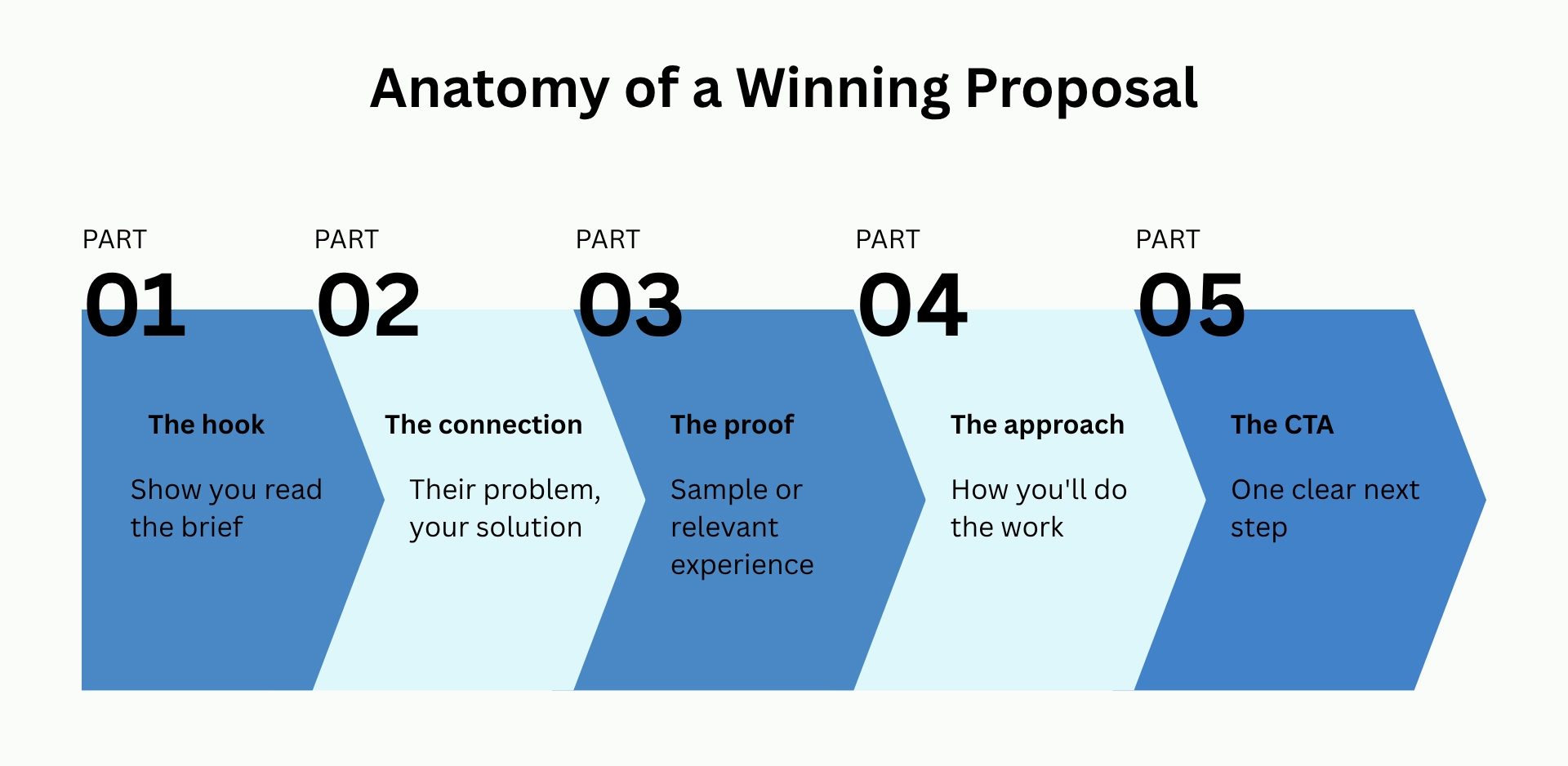
Part 1: The Hook (Show You Actually Read Their Brief)
Your first two sentences determine whether the client reads the rest. They need to feel seen.
Reference something specific from their job post. Not the generic stuff, but the detail that shows you actually read it. Their industry, their timeline, their specific challenge, even their tone if it was distinctive.
For Example,
Bad opening: “Hi, I am a content writer with 4 years of experience, and I am very interested in this project.”
Better opening: “Your brief mentioned you are launching a finance blog aimed at first-time investors. That is a niche I have written for specifically and one where tone really matters.”
The second version takes three seconds for the client to read and immediately tells them: this person read my post and knows this space. That alone puts you ahead of most of your competition.
Part 2: The Connection (Their Problem Meets Your Solution)
Write one short but powerful paragraph. Connect what they said they need to what you specifically offer.
This is not your CV. It is a bridge between their stated problem and your relevant capability.
For Example,
“You need someone who understands how to make financial content accessible without dumbing it down. That is exactly the balance I focus on. I have written beginner-friendly explainers on everything from budgeting basics to index fund investing, always with a conversational tone that keeps readers on the page.”
Notice there is no mention of years of experience, no list of other clients, no vague claim about being “passionate.” Just a clean, direct connection between their need and your ability.
Part 3: The Proof (Show, Don’t Tell)
This is where most beginners struggle, because they think they need an impressive portfolio to include proof. They do not.
Proof can be a relevant work sample. A link to a specific piece that is close to what they need. A quick result you achieved. Even a brief mini sample, two or three sentences written in the style they are looking for, can demonstrate your ability more powerfully than any credential.
For example,
“Here is a quick example of the tone I would bring to your blog. This piece explains compound interest for beginners and has been one of my client’s top-performing posts for organic traffic.”
If you have no prior client work, create a sample specifically for the application. Write the first 200 words of a post they might need. Show, do not describe.
Part 4: The Approach (How You Will Actually Do the Work)
Two to three sentences. Tell them briefly how you would handle their project. Not a full breakdown, just enough to show that you have thought through the work and have a clear process.
For Example,
“My process starts with a quick brief review call if needed, then a first draft within three days. I share Google Doc drafts with commenting enabled, so feedback is easy. Revisions are turned around within 24 hours.”
This does something important. It reduces the client’s perceived risk. They are not just imagining the deliverable now. They can see how working with you would actually feel. And it should feel organized, professional, and low-friction.
Part 5: The CTA (One Clear Next Step)
End with a specific, low-pressure invitation that makes it easy for the client to respond. “Looking forward to hearing from you” puts all the work on them. It is passive, forgettable, and gives the client nothing to act on.
Say;
“Happy to send a full sample post on a topic of your choice, just let me know what would be most useful. Or if you would prefer a quick 15-minute call first, I am flexible on timing.”
Remember, a strong call to action does three things. It removes guesswork about what happens next. It makes responding feel easy, not like a commitment. And it signals that you are professional enough to lead the process rather than leaving the client to figure it out.
Freelance Proposal Templates You Can Use Today
These are frameworks. Adapt them to your voice and the specific job. Never copy paste them word for word. The goal is structure, not script.
Upwork Proposal Template
[Specific reference to their brief. Mention their industry, their challenge, or something distinctive from the post.]
[One to two sentences connecting their need to your specific experience or approach. No generic claims. Make it relevant to them.]
I have done similar work here: [link to sample or relevant result]. [One sentence on the result or why it is relevant to their project.]
My process: [two to three sentences on how you would handle the project, including timeline, communication, and revisions.]
Happy to [share another sample / answer any questions / jump on a quick call], whatever helps you decide. Just let me know.
Keep it under 180 words on Upwork. Clients are busy, and competition is high. Shorter, sharper proposals get read more fully.
Direct Outreach Email Template
Subject line: Quick question about [their business, content, or specific thing you noticed]
Hi [Name],
[One sentence on how you found them or what caught your attention. Be specific. Their blog, a post they made, a gap you noticed on their website.]
[One to two sentences on what you do and why it is relevant to what they are working on. Keep it about them.]
[One sentence of proof, a link, a result, a quick example.]
I would love to send over a sample piece if that would make it easier to see whether this could be a fit. No strings attached, just a starting point.
[Your name]
Email outreach is warmer and more personal than a platform proposal. Match that energy. No corporate speak, no stiff formality. Write like a professional human being.
Beginner Template (When You Have No Portfolio or Reviews)
The biggest fear for beginners is the portfolio question. The fix is to lead with process and offer a sample before they ask.
[Specific hook referencing something in their brief.]
I am building my freelance portfolio in [niche], and I am specifically looking for the kind of project you have described. I cannot point to a long client history yet, but I can show you exactly what my work looks like.
[Attach or link to two or three self-created samples relevant to their niche.]
My process: [brief description of how you would handle the project]. I would work quickly, communicate clearly, and give you my full attention on this. It is the kind of work I am actively trying to do more of.
Happy to write a short sample piece for you before you decide, no commitment needed. Just say the word.
The key in a beginner proposal is turning the lack of reviews into an advantage of attention and hunger. You are not pretending to have experience you do not. You are showing work quality and commitment instead.
Freelance Proposal Dos and Don’ts
Do open with something specific from the job post. It takes 30 seconds and separates you from the majority of proposals immediately.
Don’t start with “I am a passionate [profession] with X years of experience.” It is the most common opening on any platform and signals a copy pasted proposal before the client even finishes the sentence.
Do include a link to a relevant sample or result. If you do not have one, create one for the application.
Don’t list every skill you have. Pick the one or two most relevant to this specific job and go deep on those.
Do mention a specific timeline or process, even briefly. It signals professionalism and reduces the client’s perceived risk of hiring an unknown.
Don’t write more than 200 words unless the job explicitly requires a detailed proposal. Brevity signals confident communication.
Do end with a clear, specific, easy-to-respond-to call to action.
Don’t end with “I look forward to your response” or “please feel free to contact me.” These are passive and forgettable.
Do proofread. One typo in a writing proposal is a rejection. One typo in any proposal raises doubt about your attention to detail.
Don’t discuss rate in the opening proposal unless the job post specifically asks for it. Lead with value first. Price is a conversation, not an opener.
How Long Should a Freelance Proposal Be?
The ideal length of a freelance proposal should be between 100 and 200 words for most applications. That is the sweet spot where your proposal is detailed enough to be credible and short enough to be read in full.
There are exceptions. Complex technical projects sometimes warrant a longer proposal of 300 to 400 words, especially if the client asks specific questions in their brief that need addressing. Government tenders and formal RFPs have their own requirements entirely.
But for the vast majority of freelance jobs on Upwork, Fiverr, or through direct email, shorter wins. The instinct to write more to seem more impressive is almost always wrong.
Matching Your Tone to the Client and Job Type
Read the job post like a personality profile.
A startup founder who wrote a casual, conversational brief with a bit of humor wants a different proposal than a logistics company posting a formal procurement requirement. One wants a peer. The other wants a professional.
Match their register. If their post uses informal language, loosen yours a little. If it is formal, keep yours crisp and structured. This attention to tone is itself a form of proof that you listen and adapt, which is exactly what most clients need from a freelancer.
What to Do After You Send a Proposal
Send it, then let it go. Refreshing your inbox every 20 minutes will not change anything and will only make the waiting feel longer.
Track your proposals somewhere simple: a spreadsheet, Notion, or even a notebook. Record the date, platform, client, job type, and response or no response. After 20 to 30 proposals, you will have real data to work with.
When and How to Follow Up on an Unanswered Proposal
One follow-up, 48 to 72 hours after the original. Keep it short and pressure-free.
“Hi [Name], just following up on my message from [day]. Happy to answer any questions or send an additional sample if that would help. No pressure at all, just wanted to make sure it did not get buried.”
That is it. Professional, friendly, and respectful of their time. If there is no reply after that, move on. Two messages without a response is your answer.
How to Improve Your Proposal Based on What’s Not Working
If you have sent 15 or 20 proposals with zero replies, something specific needs adjusting. Use this diagnostic.
Zero profile views? The problem is the platform or the job types you are applying for. Try a different category or a less competitive job feed.
Profile views but no proposal replies? Your opening is not landing. Rewrite the first two sentences completely and test a new approach.
Replies but no conversions to paid work? Your close is weak, or your pricing is creating hesitation. Tighten your CTA and revisit how you are handling the rate conversation.
Each of these is a specific, fixable problem. Treat your proposal like a product you are iterating, not a performance you are judging yourself by.
Conclusion
A proposal that gets replies is not magic. It is just a proposal written from the client’s perspective, with a specific hook, relevant proof, and a clear next step. Most freelancers never crack this because they keep writing about themselves.
The moment you flip that, the moment your proposal becomes primarily about what they need and how you solve it, your reply rate changes. Sometimes dramatically. Start with your very next application and see what happens.
Frequently Asked Questions About How to Write a Freelance Proposal That Gets Replies
How do I write a freelance proposal with no experience?
Lead with a self-created sample that is directly relevant to the job. Acknowledge that you are building your portfolio, but make clear that your work quality does not require a long client history to evaluate. Offering a free or discounted first sample, not a full job, gives the client a low-risk way to say yes.
How long should a freelance proposal be?
For most freelance applications, 100 to 200 words is the ideal range. Longer proposals rarely get read in full and can actually signal poor communication skills. Be specific, be brief, and let your sample or portfolio link do the heavy lifting on demonstrating quality.
Why are my freelance proposals being ignored?
The most common reasons are a generic opening that shows you did not read the brief, too much focus on your experience rather than their problem, no proof of work, and a vague or passive closing. Fixing even one of these, especially the opening, can significantly improve your reply rate.
Should I include my rate in a freelance proposal?
Generally, no, especially in the opening proposal. Lead with value and understanding of their problem. Rate becomes part of the conversation once they are interested. Some platforms, like Upwork, require a rate in the bid. Keep it in range and reasonable, but do not open with a price defense before you have shown what you can do.
How many proposals should I send per day on Upwork?
Quality over volume. Five well-crafted, personalized proposals a day will consistently outperform fifteen generic ones. Upwork also uses a Connects system that limits how many you can send, which naturally encourages being selective. Focus on jobs where your background is genuinely relevant and where the client is active and responsive.
How do I follow up on a freelance proposal?
Send one follow-up message 48 to 72 hours after your original proposal. Keep it short, friendly, and genuinely low pressure. Offer to share an additional sample or answer questions. If there is no reply after the follow-up, move on. Persistence beyond two messages becomes pushiness, which damages your reputation far more than a non-reply does.