How to Write a Freelance Profile That Gets Clients

Learn how to write a freelance profile that gets clients. Real tips for Upwork, Fiverr, and LinkedIn with before and after examples.

Let me tell you something that took me longer than I’d like to admit to figure out.
Your freelance profile is not a resume. It’s not a biography. It’s not a list of tools you can use or certificates you’ve earned.
It’s a sales page. And like any good sales page, it’s not about you. It’s about the person reading it and the problem they need solved.
Most freelancers miss this completely. They spend hours building a profile that talks about themselves and then wonder why clients aren’t coming. The profile looks fine on the surface. But it’s speaking the wrong language.
This guide fixes that. Whether you’re on Upwork, Fiverr, LinkedIn, or building your own website, these principles work across every platform. Let’s go through it properly.
Key Takeaways
- Your profile should speak to the client’s problem, not just your background
- A niche-specific title gets more clicks than a broad one every single time
- The first two lines of your overview decide whether clients keep reading
- Portfolio pieces with context and results outperform raw samples alone
- Never race to the bottom on pricing. Quality clients do not hire the cheapest option
- Your profile photo is a trust signal. Treat it like one
- Update your profile every 60 to 90 days as your results and positioning sharpen
Why Most Freelance Profiles Repel Clients Instead of Attracting Them
Most freelancers build a list of what they do without considering why the client would purchase from them.
That’s the whole problem in one sentence.
When a potential client lands on your profile, they are not thinking about you. They are thinking about their own problem. They need a blog post written by Friday, their website isn’t converting, their inbox is a disaster, and they’re three weeks behind on their content calendar.
If your profile opens with “Hi, I’m John, and I’m a passionate freelance writer with 3 years of experience,” you’ve already lost them. That sentence tells them nothing useful about their problem.
Compelling profiles explain what you provide, why this is important to your prospective client, and how they can begin working with you.
What is missing from that list? Your passion. Your journey. How long have you been freelancing? Those things can appear, but they should not lead.
Recommended: 25 Best Online Side Hustles That Pay Fast From Home
The Foundation: Pick a Niche Before You Write a Single Word
Before you touch your profile, you need to get this right. A general profile competes with every freelancer on the platform. A niche profile competes with a fraction of them and wins more often.
Think about it from the client’s perspective. If you need someone to write landing pages for your SaaS product, who do you hire? The person who says “I write all kinds of content” or the person whose profile says “I write conversion-focused landing pages for B2B SaaS companies”?
The specialist always wins. Not because they’re necessarily better at the craft, but because they signal that they already understand the client’s world.
Niching down feels scary, especially when you’re just starting. It feels like you’re turning away from more work or more opportunities. In reality, you’re just attracting better work more efficiently.
Pick a skill. Pick an industry or audience. Then position your entire profile around that combination.
Check Out: 15 Essential Skills Needed for Remote Jobs in 2026
The Profile Title: The First Thing That Gets You Clicked or Ignored
Perhaps the most important element of your profile is your title. If your title isn’t catchy enough to get a client to click, then the rest of your profile’s content is useless because it will not be seen.
That’s blunt. And it’s true.
Your title is the headline of your sales page. It determines whether a client clicks through to read the rest or scrolls past you entirely.
How to Write a Freelance Profile Title That Converts
Use this simple formula;
Niche + Outcome + Relevant keyword
Weak title: “Freelance Writer.”
Slightly better: “Experienced Content Writer Available for Hire.”
Strong title: “SEO Content Writer for Health and Wellness Brands | Blog Posts That Rank and Convert.”
That last version does three things. It names a specific niche. It signals a specific result. And it uses words clients actually search for.
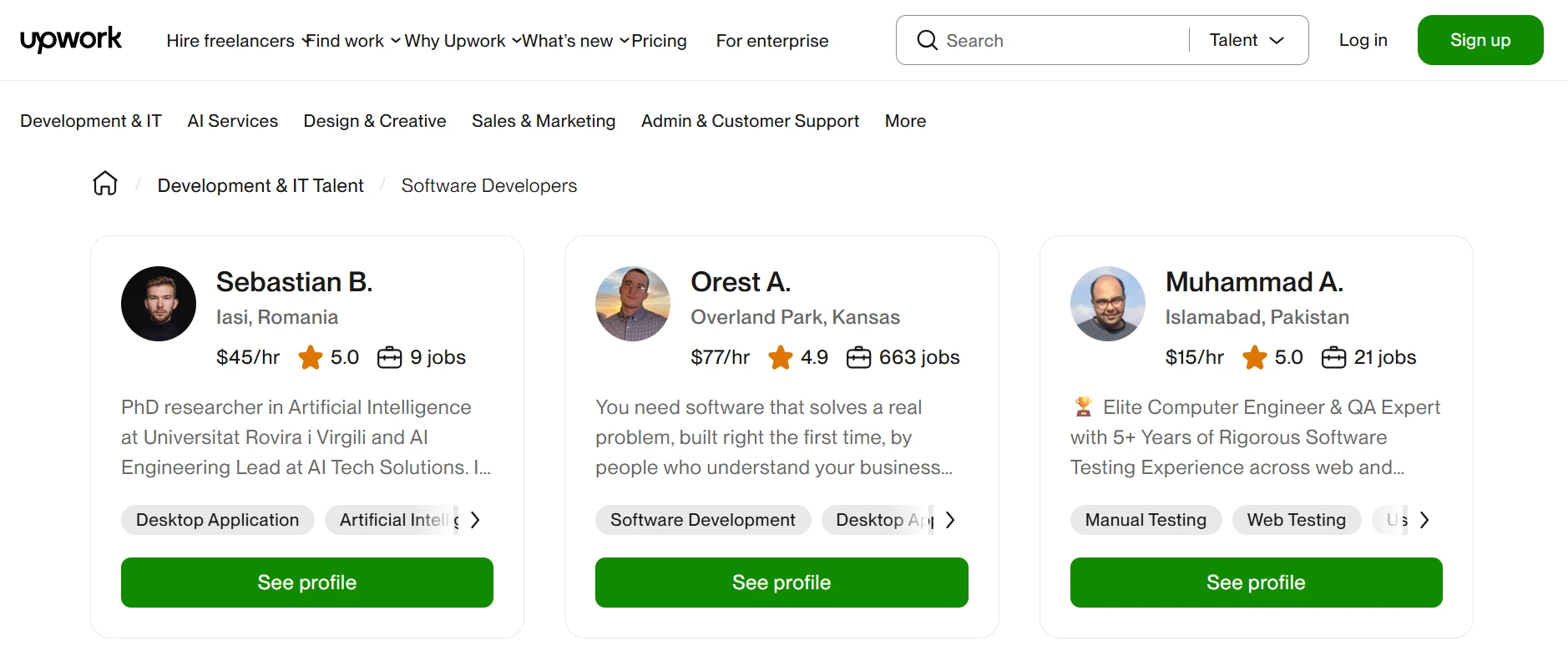
On Upwork, the Professional Title field performs better with specificity. A title like “Senior React Developer | Shopify Expert | 97% Job Success” outperforms “Web Developer” significantly.
The principle holds across all roles. More specific always beats more general.
Here’s a quick test. Read your current title and ask: could this describe 10,000 other freelancers? If yes, rewrite it until the answer is no.
How Profile Titles Differ Across Platforms
Each platform has its own rules, spoken and unspoken.
On Upwork, your title should be keyword-rich and outcome-focused. Clients search using specific terms, and the algorithm surfaces profiles that match. Research the actual words used in job postings in your niche and mirror that language.
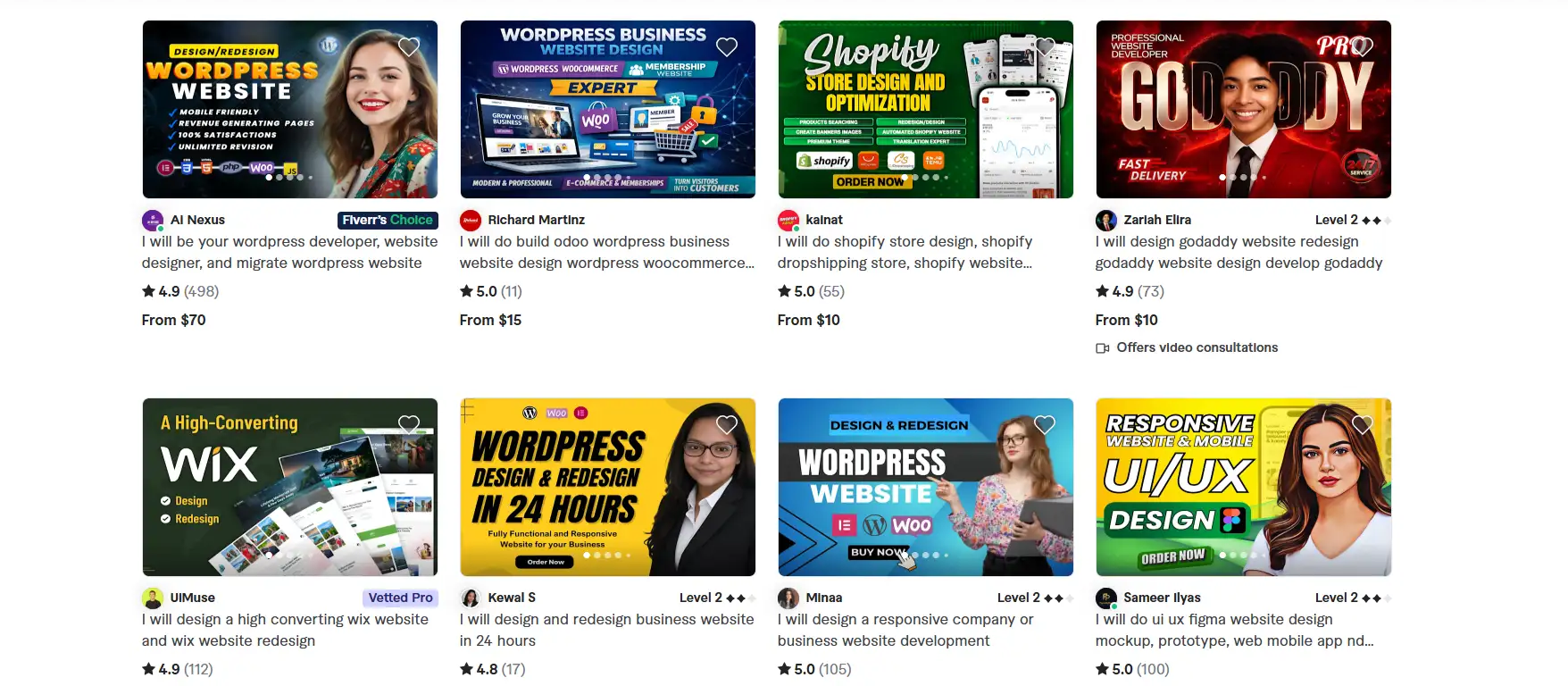
On Fiverr, the format is built around the result. Think “I will” at the beginning (as shown in the screenshot below). The general principle is to be clear about your niche, nail it down in the keywords your clients use, and be descriptive. A title like “I will write SEO blog posts for your e-commerce store” is clear and searchable.
On LinkedIn, your headline follows you everywhere. It shows up in search results, comment sections, and connection requests. Use it to state exactly who you help and how. “Freelance Email Copywriter | I Help E-commerce Brands Recover Abandoned Carts and Increase Revenue” is far better than “Freelance Copywriter | Open to Work.”
Check out: How to Get Your First Freelance Client Fast
Your Profile Photo: The Silent Trust Signal
Clients decide whether to trust you in seconds. Your photo is part of that decision, sometimes before they read a single word.
The rules here are simple. Use a real photo of your face. No logos, no cartoon avatars, no group shots cropped down to just you. Look directly at the camera. Smile, or at least look approachable. Use a clean, uncluttered background. Natural light is your friend.
You don’t need a professional photographer for this. A decent phone camera, good natural light near a window, and a plain wall behind you is enough.
The goal is to look like someone a client would feel comfortable trusting with their business. Professional but human. Polished but not stiff.
I’ve seen talented freelancers lose clients to less experienced ones simply because their photo felt off. Too dark. Too casual. Too formal. First impressions are real, even in a digital context.
Writing Your Profile Overview or Bio Section
This is where most profiles live or die. It’s your chance to speak directly to the client, show you understand their world, and convince them you’re the right choice.
The One Mistake Almost Every Freelancer Makes in Their Bio
Opening with your name and how long you’ve been doing this. It’s the freelancing equivalent of a bad first date where the other person talks about themselves the whole time.
Here’s a before and after that shows the difference clearly.
Before: “Hi, I’m Sarah. I’m a freelance graphic designer with 4 years of experience. I love creating beautiful designs, and I’m passionate about helping businesses grow. I use Figma, Webflow, and Canva.”
After: “I design high-converting websites for e-commerce brands that want to turn visitors into customers. Over 4 years, I have designed 60 or more Shopify and Webflow sites, with clients averaging a 28% increase in conversion rates after launch.”
Same person. Same experience. Completely different impact. The second version speaks to the client’s outcome, not the freelancer’s background.
The Structure That Works: A Three-Part Bio Framework
Here’s the framework I recommend for any freelance platform bio.
Part one is your hook. One to two sentences that name the client’s problem and position you as the solution. This should be the first thing anyone reads.
Part two is your proof. Show results. Numbers, specific outcomes, types of clients you’ve served, and tools you use. This is where you build trust without bragging.
Part three is your call to action. Tell the client exactly what to do next. “Send me a message with your project details.” “Let’s set up a quick 15-minute call.” Make the next step obvious and easy.
Here’s a rough template you can personalize:
“I help [target client] achieve [specific result] through [your service]. Over [X years/projects], I’ve worked with [type of clients] to deliver [specific outcomes]. If you need [result they want], let’s talk.”
That’s it. Simple, client-focused, and easy to act on.
How Long Should Your Freelance Profile Be?
It depends on the platform. LinkedIn summaries work best at 150 to 300 words. Website bios can run 200 to 500 words. Proposal bios should be 50 to 100 words. Freelance platform profiles on Upwork or Fiverr work best at 150 to 250 words. The key is to be concise and lead with your strongest credentials and results.
Longer is not better. More focused is better. Every sentence in your bio should earn its place by helping the client decide to reach out.
On first-person versus third-person: Use first person (I/my) for LinkedIn, proposals, and personal websites. It feels more authentic and personal.
Use third person (he/she/they) for press mentions, speaker bios, and formal directories. When in doubt, first person is almost always the better choice for freelancers because it creates a direct connection.
The Skills Section: Stop Listing Generic Terms, Start Listing Proof
The skills section is not the place for personality traits. “Detail-oriented,” “passionate,” and “hard-working” tell the client absolutely nothing they can verify. Every single freelancer says those things.
Instead, list tools, platforms, and specific competencies that a client might search for.
For a content writer, that’s SEO, keyword research, WordPress, Surfer SEO, Google Analytics, and content strategy.
For a virtual assistant, that’s Notion, Asana, Zapier, Google Workspace, and calendar management.
Find the keywords you need by going to job boards and looking at the Job Description and Required Experience sections of 10 different job posts. Also, use a keyword research tool like Semrush to find relevant Job keywords.
This gives you a great baseline of what keywords to add, because these are the exact words the hiring managers are using to search for and hire you.
That’s the simplest keyword research method available, and it costs nothing.
Explore websites that pay and find a remote job that fits your skills and time
Portfolio and Work Samples: Your Strongest Selling Tool
If your bio convinces a client to keep reading, your portfolio convinces them to reach out. It’s the moment where they go from interested to ready to hire.
How to Build a Portfolio With No Client Work Yet
The number one excuse new freelancers use is “I have no portfolio.” Here’s the truth. You don’t need paying clients to build a portfolio. You need work that demonstrates your skill.
Create sample projects. Write three blog posts in your niche. Design a mock brand identity for a fictional company. Build a simple landing page for a made-up product. Record a short explainer video for a service you invented.
Focus on your skills, relevant education or training, transferable experience from previous jobs, and the specific problems you solve. Include any volunteer projects, personal projects, or pro bono work that demonstrates your abilities.
A portfolio of high-quality sample work beats an empty portfolio every single time. And frankly, most clients can’t tell the difference between a sample project and a paid one if the quality is there.
Also, check out: How to Write a Freelance Proposal That Gets Replies (With Templates)
How to Present Portfolio Pieces That Convert Browsers Into Clients
Raw samples are okay. But portfolio pieces with context are far more powerful.
Every project should produce a case study of two to three paragraphs, results-focused. Build these into your profile.
The case study structure is simple. What was the client’s problem? What approach did you take? What result did it produce?
Here’s an example.
Instead of just linking to a blog post you wrote, write three sentences:
“This client needed SEO content to rank for competitive fitness keywords. I researched and wrote a 2,000-word guide targeting three long-tail keywords. The article hit page one within 90 days and now drives 400 monthly visits.”
That context changes everything. Now the client sees proof of thinking, process, and outcome. Not just a piece of writing.
Rates and Pricing: What to Say and What to Avoid
Pricing is where a lot of freelancers undermine themselves before a client even contacts them.
You never want to race to the bottom on pricing. There is no way of winning that game. Clients in the lowest price range always want massive delivery for zero cost and complain about everything. Avoid these clients. You are much better off spending your time building all the pieces of a strong profile so you find quality clients instead.
Set your rate at a level you can defend with your results. If your work produces measurable outcomes for clients, your price should reflect that value. A $50 blog post that ranks on Google and drives leads is not a $50 blog post to the client. It’s an asset.
On platforms like Upwork, starting slightly below your target rate for the first few projects to build reviews is reasonable. But build in a plan to raise your rate once you have three to five strong reviews. Never stay at a discounted rate permanently.
On Fiverr, your pricing tiers tell a story. A $10 basic package says, “I’m desperate.” A $50 basic package with a clear scope of what’s included says “I’m a professional.” Price accordingly.
Platform-Specific Profile Tips That Actually Matter
Upwork Profile Tips
Your Upwork profile is the first thing clients see when they’re deciding whether to open your proposal, browse your portfolio, or send you an invite. A polished, 100% complete profile gives you better visibility in search, eligibility for talent badges, and more trust with clients.
Fill every section. Profile photo, title, overview, skills, portfolio, work history, education, and certifications. Upwork’s algorithm rewards completeness.
Upwork now allows up to three separate profiles: one general and two specialized.
Use this…
If you write both SEO content and email copy, create a specialized profile for each. This lets you rank in more searches without diluting your positioning.
Use your overview to open with the client’s problem and close with a clear call to action. Keep it between 150 and 250 words. Get to the point fast.
Fiverr Profile Optimization Tips
On Fiverr, your gig titles and descriptions carry more weight than your profile bio. But the bio still matters because clients check it before placing an order.
Keep your Fiverr bio short and specific. Name your specialty in the first line. Mention two or three types of clients you serve well. List the tools you use. End with something that reduces hesitation, like a quick turnaround promise or a satisfaction guarantee.
On Fiverr, your bio supports your gig listings. Reference specific gigs and use the same keywords that appear in your gig titles. Consistency between your bio and gig descriptions helps the platform’s search algorithm surface your profile for the right searches.
LinkedIn Profile Tips for Freelancers
LinkedIn operates differently from freelance platforms. You’re not just waiting for clients to find you. You’re also showing up in their feed, commenting on posts, and building a presence that makes people think of you when they need what you offer.
Your LinkedIn headline should be niche-specific and outcome-focused. Your About section should follow the same three-part framework: hook, proof, call to action.
Add your portfolio work to the Featured section. This shows up prominently on your profile and is one of the first things visitors see after your headline and photo.
Turn on Creator Mode if you plan to post content regularly. It increases your profile’s discoverability and gives you access to LinkedIn’s newsletter feature, which is a great way to stay in front of potential clients consistently.
Keeping Your Profile Fresh: Why a Static Profile Kills Momentum
Here’s something most freelancers don’t think about. A profile that worked six months ago might be underperforming today.
Your results have changed. You’ve done new projects. You’ve sharpened your positioning. The market has shifted slightly. And yet most people write their profile once and leave it untouched for years.
Review your profile every 60 to 90 days. Check three things:
- Is your title still specific enough?
- Do your portfolio pieces show your best recent work?
- Do your results in the bio reflect what you can actually achieve now, not what you could do when you first started?
Small updates compound over time. A stronger title this quarter, a better case study next quarter, a new certification the quarter after that. Each refinement makes your profile a better-converting tool.
Conclusion
Writing a freelance profile that gets clients is not about being the best writer or the most talented person on the platform. It’s about speaking the right language to the right person at the right moment.
Lead with their problem, not your background. Use your title to be specific and searchable. Build a bio that has a clear structure: hook, proof, call to action. Show portfolio work with context, not just raw samples. Price yourself like a professional, not a desperate beginner.
Every element of your profile should answer one question from the client’s perspective: why should I hire this person over everyone else?
When your profile answers that question clearly and confidently, the right clients start showing up. Not the ones looking for the cheapest option. The ones who actually value the work you do.
Start with your title today. Get that right first. Then work through each section. Your profile is never really finished, it just gets better. And every improvement is another step toward the clients you actually want to work with.
Frequently Asked Questions About How to Write a Freelance Profile That Gets Clients
How do I write a freelance profile with no experience?
Create sample projects that demonstrate your skill rather than waiting for paying clients. Write mock blog posts, design spec brand identities, or build sample workflows. Include volunteer work or personal projects. Clients care about proof of skill, not whether someone paid you for it first.
How long should a freelance profile overview be?
On Upwork and Fiverr, aim for 150 to 250 words. On LinkedIn, 150 to 300 words works well. Personal website bios can run up to 500 words. The goal is clarity and focus, not length. Every sentence should either address the client’s problem or build trust in your ability to solve it.
What should I put in my freelance profile title?
Your title should name your niche, signal your specialization, and include keywords clients actually search for. Combine your service, your target audience, and a result where possible. “Email Copywriter for E-commerce Brands” is far stronger than “Freelance Copywriter Available for Projects.”
How do I make my Upwork profile stand out with no reviews?
Fill every profile section to 100% completion. Use a strong, niche-specific title. Open your overview with the client’s problem. Add high-quality portfolio samples, even mock projects. Apply to smaller jobs first to build early reviews. A complete, client-focused profile outperforms an incomplete one regardless of review count.
Should I list my rates on my freelance profile?
On platforms like Upwork, setting a rate is required. Set it at a level you can justify with results, not the lowest number you think will get clicks. Cheap rates attract difficult clients. A fair, professional rate signals confidence and filters for clients who value quality work over bargain prices.
What is the best way to structure a freelance bio?
Use a three-part structure. Open with a hook that speaks to the client’s problem. Follow with proof: specific results, types of clients served, tools used, and measurable outcomes. Close with a clear call to action that tells the client exactly what to do next. Keep it concise and client-focused throughout.