How to Start Affiliate Marketing for Beginners: A Complete Step-by-Step Guide

Ready to start affiliate marketing but not sure where to begin? This comprehensive step-by-step guide covers everything — from choosing your niche to making your first commission with honest, practical advice for complete beginners.

If you’ve been trying to figure out how to start affiliate marketing as a beginner and ended up more confused after reading three different articles than you were when you started, that’s not your fault.
Most guides either go too shallow, covering only the basics without explaining how anything actually works, or they push you toward a tool or course before you even understand what you are building.
In this guide, I am going to walk you through everything, from understanding what affiliate marketing is to choosing your niche, picking programs, building a platform, creating content that converts, getting traffic, and building an income that does not disappear when you stop working.
I have built websites, tested strategies, and learned a lot from both the things that worked and the ones that did not. What you are about to read is the guide I wish I had when I started.
Take your time with it. By the end, you will have a clear picture of exactly what to do and in what order.
TL;DR
Affiliate marketing is a model where you earn a commission for recommending other people’s products. You choose a niche, join affiliate programs, create content that ranks on Google and builds trust with readers, drive traffic to that content, and capture an email list for long-term income. It takes time, but it is one of the most accessible online income models available to beginners today.
One thing that helps a lot is having a simple system behind your content and email strategy. That is where the H.E.A.R.T funnel formula comes in. Instead of pushing links everywhere, the H.E.A.R.T approach focuses on building trust first, helping readers solve real problems, and guiding them naturally toward the right offers. That makes affiliate marketing feel less forced and usually leads to better conversions over time.
What Affiliate Marketing Actually Is (and How the Whole Thing Works)
Affiliate marketing is one of those terms that gets used everywhere but rarely explained clearly.
Here is the simple version…
A company has a product they want to sell. Instead of spending all their money on advertising, they allow other people, called affiliates, to promote that product. When someone clicks your unique affiliate link and makes a purchase, you earn a percentage of that sale as a commission. The company gets a customer, the customer gets a product, and you get paid for making the introduction.
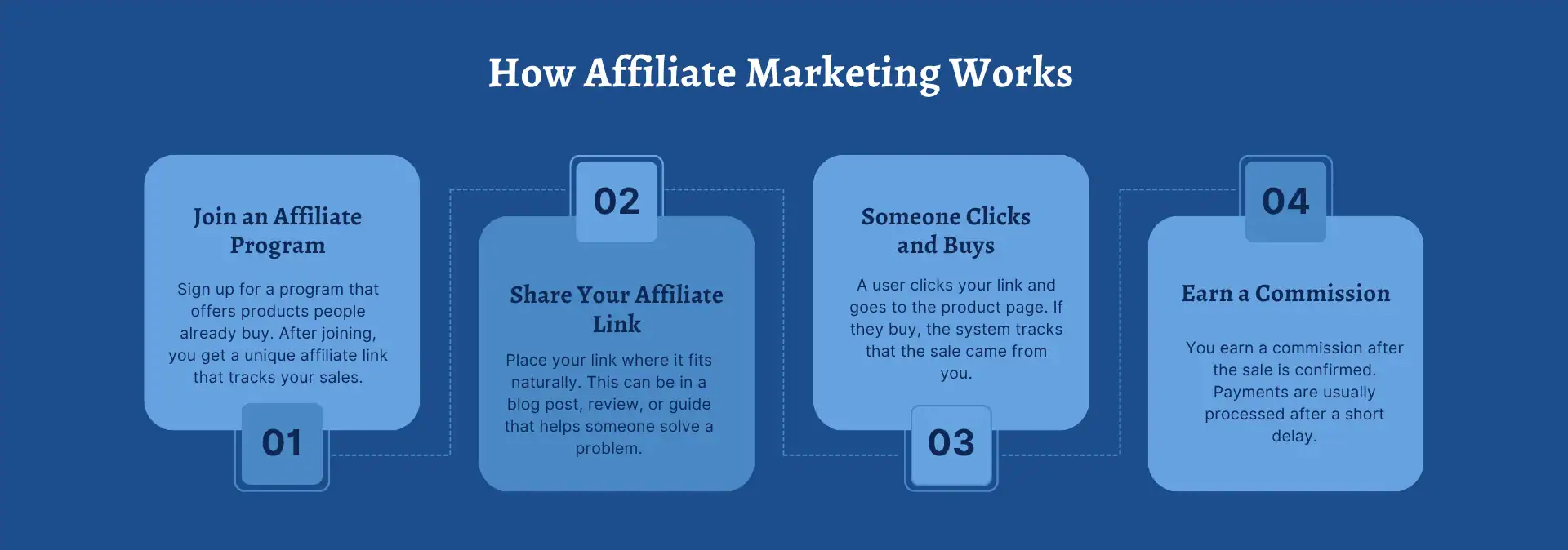
That is the whole model. You are the connector between a buyer who needs something and a company that sells it.
You never handle inventory. You never deal with customer service. You never create the product yourself. Your job is to create content that attracts the right people, earns their trust, and guides them toward a product that genuinely helps them.
The Three Main Players
Every affiliate marketing transaction involves three parties.
The merchant. This is the company or individual who creates and sells the product. It could be a software company like Hostinger, a course platform, a physical product brand, or a SaaS business. They run an affiliate program and pay commissions to people who send them buyers.
The affiliate. That is you. You create content, build an audience, and promote the merchant’s products through your unique affiliate links. You earn a commission whenever someone buys through your link.
The customer. The reader, viewer, or follower who finds your content, learns about a product through your recommendation, and makes a purchase. They do not pay more because of your link. The commission comes from the merchant’s side.
Some people also talk about a fourth player, the affiliate network, which is a platform that connects affiliates with multiple merchant programs in one place. More on that shortly.
How You Actually Get Paid
This is where many beginners have questions, so let me break it down clearly.
When you join an affiliate program, you get a unique tracking link. That link has your affiliate ID embedded in it. When someone clicks your link, a small file called a cookie is stored in their browser. That cookie tracks the session and, depending on the program, stays active for a set period.
If the person buys the product within that period, the sale is tracked back to you, and you earn the commission. Cookie windows vary widely. Some programs give you 24 hours. Others give you 30, 60, or even 90 days. Longer cookie windows are generally better for you as an affiliate.
Payment methods also vary by program. Most pay through PayPal, bank transfer, or direct deposit. Payment thresholds differ too. Some programs pay once you reach $10 in earnings, others require $50 or $100. Always check these details before joining a program.
Why Affiliate Marketing Is One of the Best Models for Beginners
There are several ways to make money online. Freelancing, selling digital products, dropshipping, and running a YouTube channel. All of them can work. But affiliate marketing has specific advantages that make it particularly well-suited to people who are just getting started.
You do not need to create a product. This removes one of the biggest barriers to earning online. You skip the entire product creation, packaging, and fulfillment process. You focus entirely on content and audience.
The startup costs are low. You can start an affiliate marketing blog for less than $50 per year. A domain name, basic hosting, and a free WordPress theme are all you need in the beginning.
You can earn while you sleep. Once a piece of content ranks on Google and has your affiliate links embedded, it can generate commissions every day without you touching it. That is the passive income element that makes this model appealing.
You can start without an existing audience. Unlike influencer marketing, you do not need thousands of followers to earn your first commission. A single well-written blog post that ranks on Google for the right keyword can start generating clicks and sales.
You can promote products in almost any niche. Whether your interest is personal finance, fitness, travel, cooking, technology, or parenting, there are affiliate programs available. The options are wide.
None of this means it is easy. It takes work, time, and consistency. But the barriers to entry are genuinely lower than almost any other online income model, which is why it makes sense for beginners.
Step 1: Choose Your Niche (This Decision Shapes Everything Else)
Before you write a single word, join a single program, or touch a website builder, you need to decide what your content is going to be about. That is your niche.
A niche is a specific topic area. Not “health,” but “fitness for busy mothers over 40.” Not “finance,” but “paying off student loans on a low income.” The more specific your niche, the easier it is to build an audience that trusts you and the easier it is to rank on Google for targeted searches.
This is the decision most beginners rush. Then they build three months of content, realize the niche has no affiliate products worth promoting, and start over. Getting this right upfront saves a lot of wasted effort.
What Makes a Good Niche for Affiliate Marketing
A strong niche for affiliate marketing sits at the intersection of three things.
It should be something you have a genuine interest in or knowledge about. You will be creating a lot of content in this niche. If you find the topic boring, your content will reflect that.
It should have a real audience searching for information. Use a keyword tool to check whether people are actively searching for content in this space. A niche with no search volume is a niche with no organic traffic.
It should have affiliate products worth promoting. Before committing to a niche, check whether there are products, tools, courses, or services in that space with affiliate programs that pay decent commissions. No products, no commissions.
Profitable Niches Worth Considering
Some niches consistently produce strong affiliate income because there is high buyer intent and a wide range of products to promote.
Personal finance and money management are strong performers. People searching for ways to budget, invest, get out of debt, or earn extra income (the space this site operates in) are in an active buying mindset. Software, courses, and financial tools all carry solid affiliate commissions.
Health and wellness is highly competitive but has deep affiliate opportunities across supplements, fitness programs, mental wellness apps, and health courses.
Online business and digital marketing have some of the highest affiliate commissions available. Software tools, email platforms, course builders, hosting providers, and marketing tools all pay well.
Technology and software reviews attract buyers who are ready to make decisions. When someone searches “best project management software,” they are usually very close to buying. That buyer intent makes this a strong space.
Relationships, parenting, home improvement, travel, and pets all have active audiences and affiliate products available. Pick based on your own knowledge and interest, then validate the affiliate opportunities before committing.
How to Validate That Your Niche Has Earning Potential
Before you commit, spend 30 minutes doing three checks.
Search your niche topic on Google and look at what comes up. If you see other content sites, review pages, and affiliate-type content ranking, that is a good sign. It means the niche has proven traffic.
Go to Google and type your niche topic plus “affiliate program.” You should find multiple programs with reasonable commissions. If you struggle to find even three, the niche may be too small.
Use a free keyword tool to check search volume for the main topics in your niche. Even small monthly search volumes in a focused niche can generate consistent traffic once your content ranks.
Step 2: Find and Join the Right Affiliate Programs
Once you know your niche, the next step is identifying which affiliate programs you are going to promote. This is where a lot of beginners make the mistake of joining every program they can find without thinking about fit or quality.
Types of Affiliate Programs
There are three main program types worth understanding.
Direct affiliate programs. These are run by individual companies. You go directly to the company’s website, find their affiliate or partner program page, and apply. Many software and hosting companies run their own programs.
Affiliate networks. These are platforms that aggregate hundreds or thousands of programs in one place. ShareASale (now Awin), CJ Affiliate, Impact, and PartnerStack are examples. You apply to the network once and can then apply to individual programs within it. Networks are useful for finding products in niche markets.
High-ticket affiliate programs. These are programs where the products are more expensive, often software, online courses, or coaching programs, and the commissions per sale are significantly higher. One sale might earn you $100 to $500 or more. These require a warmer, more trust-based audience to convert, so they usually work better after you have built some traction.
Amazon Associates is often the first program beginners consider because of the brand recognition and the sheer number of products available. The commissions are low, usually between 1 and 10 percent, but it can work well for product review content in physical product niches.
What to Look for Before Joining a Program
Not all affiliate programs are worth your time. Here is what to evaluate before applying.
Commission rate matters, but it is not the only factor. A 50 percent commission on a $20 product is $10. A 20 percent commission on a $200 product is $40. Think about the commission in dollar terms, not just percentage terms.
Cookie duration affects how long after a click you can earn a commission. Thirty days is standard. Shorter than 14 days is generally less favorable.
Payment terms tell you when you get paid and how. Monthly payments with a reasonable minimum threshold are fine. Watch for programs with very high minimums or unclear payment processes.
Product quality is the one thing people overlook most. You are putting your reputation behind every product you recommend. Promoting poor-quality products to your audience destroys trust faster than anything else. Always research or, ideally, use the product yourself before promoting it.
Program stability matters too. A new or unknown company running an affiliate program carries more risk than an established brand. If the program shuts down or changes its terms, your income from it disappears.
Where to Find Good Affiliate Programs
The most direct way is to search Google for products you already use or trust, then look for their affiliate or partner program page. Most are easy to find.
You can also search “[your niche] + affiliate program” on Google and browse the results.
Affiliate networks like ShareASale, Impact, and PartnerStack let you search by category and filter by commission rate, which saves a lot of research time.
Another approach is to look at what other content sites in your niche are promoting. Check their resource pages, review posts, and disclosure statements. You will quickly learn which programs are popular in your space.
Step 3: Build Your Platform
You need a place to publish your content, collect your audience, and house your affiliate links. This is your platform.
Why a Blog or Website Is Still the Strongest Foundation
Social media platforms come and go. Algorithms might shift or reach drops. One policy change can make your account invisible overnight.
A website you own and control is different. The content you publish there does not disappear. It compounds over time as Google indexes more of your pages and sends consistent search traffic. The email list you build from your site belongs to you regardless of what happens on any social platform.
This is why, after years of watching different approaches, I keep coming back to the same recommendation. Build a website first. Everything else becomes an amplifier on top of that foundation.
How to Set Up Your Affiliate Marketing Website
Setting up a site is simpler than most beginners expect. You do not need to know how to code.
Step 1. Choose a domain name. Pick something short, easy to spell, and relevant to your niche. Keep it simple. Avoid hyphens and numbers.
Step 2. Get reliable hosting. Your hosting provider is where your website lives on the internet. Hostinger is the one I recommend for beginners. The plans are affordable, the setup is beginner-friendly, and the performance is solid for the price. They also include a free domain with some plans, which is useful when you are just getting started. Their support is responsive, which matters when you run into questions early on.
Step 3. Install WordPress. WordPress powers over 45 percent of the internet for a reason. It is flexible, has thousands of themes and plugins, and most hosting providers, including Hostinger let you install it in one click.
Step 4. Choose a clean theme. You do not need a premium theme to start. Choose a clean, fast-loading theme that works well on mobile devices. Focus on readability instead of complex design at this stage. I recommend Kadence or Astra because of their lightweight and easy customization.
Step 5. Install essential plugins. A few are worth adding early: an SEO plugin like Rank Math or Yoast, a caching plugin for speed, and a basic contact form plugin. Do not overload your site with plugins.
Step 6. Create your core pages. Before you start publishing content, set up an About page, a Contact page, a Privacy Policy, and an Affiliate Disclosure page. The disclosure is legally required in most countries whenever you use affiliate links.
That is the foundation. It takes an afternoon if you follow each step without overthinking it.
Can You Do Affiliate Marketing Without a Website?
Yes, but with real limitations.
Some affiliates use YouTube channels, Instagram, TikTok, or Pinterest as their primary platform. These can work, particularly if you have strong video skills or a visual niche. But social platforms do not give you the same control, search traffic consistency, or email list-building opportunity that a website does.
The most effective long-term approach is to have a website as your base and use social platforms to drive traffic back to it. Not the other way around.
If budget is a genuine concern right now and you cannot afford hosting, starting on a free blog platform like Blogger or WordPress.com and moving to self-hosted hosting later is a reasonable temporary step. Just know that at some point, the switch becomes necessary.
Step 4: Create Content That Earns Trust and Drives Clicks
Your content is the engine of your affiliate marketing business. Every affiliate commission you earn starts with someone reading, watching, or consuming something you created. Getting the content right is not optional.
The Content Types That Drive Affiliate Sales
Not all content converts equally. Some content types are naturally better at moving readers toward a purchase decision.
Product reviews. A detailed, honest review of a specific product is one of the highest-converting content types in affiliate marketing. When someone searches “Semrush review,” they are researching before a purchase. That is exactly the right moment to reach them with a thorough, experience-based review.
Product comparison posts. “Semrush vs Ahrefs” or “Hostinger vs Bluehost” attract readers who have already decided to buy something but are choosing between options. These readers convert at a very high rate because the buying decision is already mostly made.
Best-of lists. “Best email marketing tools for small businesses” or “best affiliate programs for beginners” attract readers in research mode. They are looking for options. Your job is to present the right ones clearly and help them make a decision.
How-to tutorials. Step-by-step guides that solve a specific problem and naturally recommend a tool as part of the solution. This article is an example of that format. The recommendation fits naturally because the tool solves a real problem being discussed.
Resource pages. A curated page listing all the tools, books, courses, and resources you use and recommend. These pages are low-effort to maintain and can generate consistent passive clicks over time.
How to Write Content That Both Ranks and Converts
There is a balance to strike between writing for search engines and writing for human readers. Get this wrong in either direction, and your content underperforms.
For Google, you need to use your target keyword naturally throughout the content, structure your post with clear headings, cover the topic comprehensively, and earn links from other sites over time.
For readers, you need to answer their questions quickly, write in a way that feels human and trustworthy, be honest about both the pros and the cons of any product you review, and not overload the content with affiliate links to the point where it feels like a sales pitch.
The content that ranks and converts almost always does both well. It answers the question thoroughly, earns the reader’s trust by being honest, and then presents an affiliate recommendation that feels like a natural part of the solution.
One practical rule. For every affiliate recommendation you include, explain who it is best for, what it does well, and if there is a meaningful downside, mention it. Readers can tell when a review is balanced versus when someone is just trying to get a click. Balanced content builds the kind of trust that produces repeat readers and consistent affiliate income.
Understanding Search Intent in Affiliate Marketing
Search intent is the reason behind a search. When someone types a query into Google, they have a specific goal in mind. Google has gotten very good at figuring out that intent and ranking content that matches it.
Informational intent means the person wants to learn something. “What is affiliate marketing?” is informational. These searches bring traffic but convert at a lower rate.
Buyer intent means the person is close to making a purchase decision. “Best SEO tool for beginners” or “Hostinger review” are buyer intent searches. These convert at a significantly higher rate because the reader is already in decision mode.
Commercial investigation intent sits in between. The person is comparing options and doing research. “Semrush vs Ubersuggest” is an example. These also convert well for well-written comparison content.
As you build out your content plan, mix all three, but weight your affiliate-focused content toward buyer and commercial investigation intent. That is where the conversions happen.
Step 5: Drive Consistent Traffic to Your Content
You can have the best content in your niche and earn nothing from it if nobody finds it. Traffic is the lifeblood of an affiliate marketing business. Here is how to build it.
Organic Search Traffic — SEO
SEO stands for search engine optimization. It is the practice of making your content more likely to appear in Google search results when people search for topics you write about.
This is the most valuable long-term traffic source for affiliate marketers. A post that ranks on page one of Google for a relevant keyword can generate traffic every day for years without any ongoing effort.
SEO has three core components…
- First is keyword research, finding the specific searches your target audience types into Google, prioritizing ones with meaningful volume and manageable competition.
- Second is on-page optimization, using your target keyword in the right places, structuring your content clearly, and covering the topic well enough to earn a top position.
- Third is building authority over time through consistent publishing and earning links from other websites.
A tool that makes keyword research significantly more effective is Semrush. It shows you exactly how many people search a given keyword each month, how competitive the ranking is, and what your competitors are ranking for. I use it regularly to find content opportunities that have real search volume and a realistic chance of ranking. The free plan gives you enough data to get started, and you can upgrade as your site grows.
SEO takes time. Most content takes three to six months to start ranking. This is why starting early matters. The content you publish today will be building traction months from now.
Social Media Traffic
Social platforms can amplify your reach, especially while your SEO is still building. Pinterest, for example, works more like a search engine than a social feed and can drive significant traffic to blog content in the right niches. Instagram and TikTok work well for visual niches and can build an audience faster than SEO.
The approach that works best is creating short-form social content that solves a small problem or sparks curiosity, then directing people to your website for the full answer or resource. This builds your email list and deepens the relationship with your audience in a way that social follows alone do not.
Do not try to master every platform at once. I suggest picking one or maybe two that fit your niche and communication style. Build it consistently alongside your blog content.
Email Traffic
This one deserves its own section, and it is coming up next. But within the traffic conversation, understand this. Email is not usually listed as a traffic source, but it is. Every time you send an email to your list, you drive a wave of warm, engaged readers back to your content. These readers already know you, trust you, and are significantly more likely to click an affiliate link than a cold visitor from Google.
Building an email list from day one means you have a traffic source you fully control, regardless of what happens to search rankings or social algorithms.
Step 6: Build Your Email List From Day One
If I could go back and change one thing about how most beginners approach affiliate marketing, it would be this. They focus entirely on getting traffic and almost completely ignore capturing that traffic into an email list.
Your email list is the most valuable asset in your entire business. Here is why.
Search rankings fluctuate, especially with Google’s Helpful Content Updates. A single algorithm change can cut your organic traffic in half overnight. But your email list stays with you. Those subscribers chose to hear from you. That relationship belongs to you regardless of what any algorithm does.
Email also converts at a much higher rate than cold traffic. A reader who has received five helpful emails from you and then gets a recommendation for a tool is far more likely to click and buy than a reader who landed on your review post from Google for the first time.
Setting up a basic list-building system does not have to be expensive. Systeme.io has a free plan that covers everything you need early on — an email marketing system, landing page builder, and basic automation in one place. You can set up a simple opt-in form on your site, offer a free resource like a checklist or short guide in exchange for an email address, and start building your list from your very first visitors.
What should you send your list? Start simple. A welcome email that introduces yourself and sets expectations. A weekly or bi-weekly email that shares something useful, a tip, a short tutorial, a resource, or a behind-the-scenes look at something you are working on. Occasionally, you introduce a product you genuinely recommend.
Here is an example of a welcoming email template.
Hey [First Name],
Thanks for joining.
If you are trying to lose weight, build muscle, or improve your health, you are in the right place.
There is a lot of fitness advice online, and most beginners end up overwhelmed. My goal is to make things easier by sharing simple workouts, healthy habits, and beginner-friendly fitness tips that actually make sense.
Here’s what you can expect from my emails:
- Easy workout routines
- Simple meal and nutrition tips
- Fitness tools and products I recommend
- Beginner mistakes to avoid
- Motivation and consistency tips
I will also share some products and tools that may help you. Some links may be affiliate links, meaning I may earn a small commission if you buy through them.
Start simple. You do not need a perfect routine to make progress.
Here’s a beginner’s guide to help you get started:
[Insert your fitness guide or free workout]
Talk soon,
[Your Name]
The relationship you build through email is the closest thing to real trust you can build at scale online.
Step 7: Track Your Results and Improve Over Time
A lot of beginners publish content and then wait passively, hoping something works. The ones who grow faster do something different. They watch what is happening and use that information to improve.
You do not need complex tracking systems. At the start, a few basics cover most of what you need to know.
Google Search Console is free and shows you exactly which keywords your content is appearing for in Google, how often people click through, and where your pages are ranking. Connect it to your site on day one and check it regularly. It tells you which posts are gaining traction and which need more work.
Google Analytics shows you how people are behaving on your site. How long they stay, which pages they visit, where they come from, and where they drop off. Free and essential.
Affiliate dashboard tracking most affiliate programs have a dashboard that shows you clicks, conversions, and earnings. Pay attention to your click-through rate on affiliate links and your conversion rate. If you are getting clicks but few conversions, the offer might not match your audience well. If you are getting little traffic to a page with a strong offer, you need to focus on promotion.
The simple habit to build is checking these numbers weekly. Look for patterns. Which posts drive the most affiliate clicks? What kind of content brings in the most engaged readers? What do your top-performing posts have in common? Then create more of what is working.
Growth in affiliate marketing is almost always an iterative process. You publish, observe, improve, and repeat. The marketers who treat their content as experiments they learn from, not just outputs they produce, grow significantly faster.
How Long Does It Take to Make Money With Affiliate Marketing?
This is the question most beginners want answered honestly. So here it is.
Most beginner affiliate marketers see their first commission somewhere between three and six months of consistent work. Some see it earlier if they publish frequently, target the right keywords, and choose programs with lower conversion thresholds. Some take longer if they are in a highly competitive niche or starting on a platform with lower traffic potential.
What “consistent work” means in this context is publishing two to four quality pieces of content per week, doing basic SEO on each post, building your email list from the start, and promoting your content through at least one additional channel alongside your blog.
The people who make money faster are almost always the ones who treat it like a business from day one rather than a casual experiment. They follow a clear plan. They publish regularly. They track what works and adjust.
How Much Can You Actually Earn?
Affiliate marketing income varies enormously based on niche, content quality, traffic volume, and consistency of effort. But here are realistic reference points to help you calibrate expectations.
In the first three to six months, while you are building content and waiting for SEO traction, most beginners earn between $0 and $200 per month if they are working consistently. This phase is about building the foundation, not collecting a paycheck.
Between six months and a year, with consistent publishing and a growing backlink profile, monthly earnings commonly range from $100 to $1,000 per month, depending on the niche and programs.
Between one and two years, affiliates who stick with it and keep improving their content and traffic strategy frequently earn between $1,000 and $5,000 per month. Some earn more. This is the stage where the compounding nature of SEO-based content really starts to show.
Experienced affiliate marketers with established sites in profitable niches commonly earn between $5,000 and $50,000 per month or more. These are not overnight results. They are the product of years of consistent effort.
The model works. But it rewards patience and consistency more than almost anything else.
Mistakes Beginners Make That Delay Their Results
These are real patterns I have seen consistently. Learning from them now will save you months of frustration.
Choosing a niche based purely on profit potential. If you have no genuine interest or knowledge in the space, your content will be thin, your enthusiasm will run out, and your readers will feel the difference. Pick something you can write about for two years without burning out.
Trying to join too many affiliate programs at once. It feels productive to collect affiliate relationships. But spreading across twenty programs with thin content on each produces far less than going deep on three or four strong programs that fit your niche well.
Publishing inconsistently. One post a month does not build a content business. You need volume to build domain authority and give Google enough to work with. Two to four posts per week, even if shorter, beats one long post per month.
Ignoring SEO entirely. Writing great content that nobody finds is a heartbreaking experience. Even basic SEO work, using a keyword tool, structuring posts properly, and targeting realistic search queries, makes a significant difference in how quickly content starts gaining traction.
Treating affiliate links as the content rather than part of it. Readers come to your site for information and help. They stay and click because you earned their trust. If your content reads like a sales page rather than a helpful resource, both your readers and Google will notice.
Skipping the email list. By the time most beginners realize how important this is, they have already sent thousands of readers off their site with no way to follow up. Start building your list from the very first visitor.
Giving up before the compound effect kicks in. Affiliate marketing is a delayed gratification game. The work you do in month two often does not pay off until month six or seven. Most people who fail quit right before the turning point.
Trying to figure out everything alone. There is a real cost to guessing your way through a complex process. A structured resource that lays out the path clearly saves an enormous amount of time and avoids the costly detours.
If you are serious about building affiliate income through a proper funnel system rather than just scattered links, THE H.E.A.R.T Funnel Formula gives you the exact framework I use for turning content into consistent affiliate commissions. It is built for beginners who want to understand the full picture, from attracting an audience to making conversions, through a method based on trust rather than pressure.
Conclusion
Affiliate marketing is not a shortcut. But it is one of the most accessible, realistic ways to build online income available to complete beginners today.
You now have the full picture.
- Choose a niche you can go deep on.
- Join programs that pay fair commissions on products worth recommending.
- Build a website that you own and control.
- Create content that genuinely helps your readers and naturally introduces the right products.
- Drive traffic through SEO, social media, and most critically, your email list.
- Track what works and keep improving.
That is the whole framework. Everything else is execution.
The beginners who build real affiliate income are not the ones with the most talent or the biggest budget. They are the ones who follow a clear plan, stay consistent through the slow phase, and treat every piece of content as a long-term asset.
Start with one niche. One website. One or two affiliate programs. One content publishing rhythm. Build from there.
If you want to explore more related topics, take a look at how to grow an affiliate marketing blog with SEO, or read through the best passive income strategies for beginners. Both connect directly to what you have just learned here.
Frequently Asked Questions: How to Start Affiliate Marketing for Beginners
How do I start affiliate marketing as a complete beginner with no experience?
Start by choosing a niche you have genuine interest in and that has affiliate products available. Set up a basic website or blog, join two or three affiliate programs that fit your niche, and begin publishing helpful content that targets specific search queries your audience is typing into Google. Focus on building an email list from your first visitors. Consistency and a clear plan matter more than any technical skill at this stage.
Do I need money to start affiliate marketing?
You can start with as little as $30 to $50 per year for a domain name and basic hosting. Many essential tools, including keyword research, email marketing, and analytics, have free plans that cover everything you need in the early stages. You do not need a large budget. You need time, consistency, and a structured approach to content creation.
How long does it take to make money with affiliate marketing?
Most beginners who publish consistently and apply basic SEO see their first commission within three to six months. Reaching $500 to $1,000 per month typically takes between six months and a year of consistent effort. Affiliate marketing rewards patience. The compounding effect of quality content and SEO takes time to show up, but it becomes significant once it does.
Do I need a big audience to make money with affiliate marketing?
No. Unlike social media influencing, affiliate marketing does not require a large following. A single blog post ranking on page one of Google for a buyer-intent keyword can generate consistent commissions from an audience of strangers who discover it through search. What matters is content quality, search intent alignment, and trust, not follower count.
What are the best affiliate programs for beginners?
The best programs for beginners are ones with products relevant to your niche, fair commission rates, transparent payment terms, and a reputable brand behind them. Direct programs from companies like Hostinger, Systeme.io, Semrush, and others in the online business space pay well and have strong support for affiliates. Amazon Associates works well for physical product niches despite its lower commission rates.
Can I do affiliate marketing without a website?
Technically yes, using YouTube, Pinterest, TikTok, or email alone. But without a website, you lack a stable content home that compounds over time, a consistent source of organic search traffic, and the cleanest mechanism for building an email list. Most successful affiliate marketers use a website as their primary foundation and use social platforms to drive additional traffic back to it.