The Compounding Effect of Online Income: Why Growth Looks Slow Before It Accelerates

The compounding effect of online income is real, but the slow early phase is what most beginners never survive. This honest guide explains what is actually happening during the flat part of the curve and why staying changes everything.

About eight months into building my first affiliate site, I decided to look back at something I had been tracking from the beginning.
I opened a spreadsheet and reviewed my monthly organic traffic numbers. What stood out immediately was not how much traffic I had. It was how the growth had happened.
- Month 1: 34 visitors
- Month 2: 61 visitors
- Month 3: 88 visitors
- Month 4: 140 visitors
- Month 5: 230 visitors
- Month 6: 410 visitors
- Month 7: 780 visitors
- Month 8: 1,540 visitors
I had been staring at those numbers one month at a time, feeling like almost nothing was happening. Looking at them side by side for the first time, the shape was unmistakable. The numbers in months one through four looked depressingly small. The numbers in months five through eight looked like a different story entirely.
The work was compounding the entire time. I just couldn’t see it happening until I had enough data to show me the shape it was making.
This is the specific thing most beginners never discover, not because they’re doing anything wrong, but because they quit before the shape becomes visible. This guide is about that shape, what it looks like from the inside, what it hides from you while it’s forming, and why staying is almost always the correct decision even when nothing seems to be working.
Quick Answer
The compounding effect of online income means that each piece of content, each client relationship, each email subscriber, and each published article builds on the previous one in a way that accelerates over time. The early phase produces almost nothing visible while a significant amount of foundation is being laid. Most beginners experience three to twelve months of flat-looking growth before the curve begins to steepen. The ones who understand this and stay through the flat phase are the ones who eventually describe their income as “exponential.” The ones who quit during it never find out what was coming.
TL;DR
- The compounding effect of online income is real, measurable, and predictable, but it is nearly invisible during the phase when the foundation is being laid.
- Content published today does not earn at its peak rate today. It earns more six months from now, and more again six months after that.
- The specific moment most beginners quit, usually months three through six, is almost always inside the flat phase rather than after it.
- Knowing what compounding looks like before it becomes visible in income helps you stay through the phase where staying is the entire game.

Compounding Looks Slow Until It Doesn’t
Most people quit during the phase where the work is happening, but the results are hard to see. The challenge isn’t usually effort. It’s staying consistent long enough for that effort to compound. The First Dollar Blueprint gives you a simple 7-day action plan with one focused task each day, helping you build the kind of momentum that small wins can grow from over time.
The Compounding Effect of Online Income: A Quick Summary
| Phase | Timeline | What’s Happening | What It Feels Like | What You Should Do |
|---|---|---|---|---|
| Stage One: Foundation Phase | Months 1–6 | Domain authority building, content indexing, email list growing, reputation accumulating | Nothing is working. Effort feels wasted. | Keep publishing. Keep pitching. Trust the process. |
| Stage Two: Emergence Phase | Months 6–12 | Traffic growing meaningfully, email list warming, referrals starting, first consistent income | Something is shifting. Still fragile. | Stay consistent. Don’t over-correct based on partial data. |
| Stage Three: Acceleration Phase | Months 12+ | Content ranks faster, recommendations convert, inbound enquiries replace cold outreach | Income feels real. Momentum is visible. | Keep the same consistency that got you here. Add systems. |
Compounding Signals: What to Track Before Income Arrives
| Signal | What It Means | Why It Matters |
|---|---|---|
| Content indexes faster than before | Domain authority is building | Your site is being recognised as a reliable publisher |
| Old content ranks for new keywords | Topical authority is growing | The domain is seen as relevant in your niche, not just for one topic |
| Email open rates hold steady as list grows | Trust is compounding | Subscribers who stay are becoming more valuable over time |
| Inbound enquiries start appearing | Reputation is spreading | Your work is being talked about in channels you don’t control |
| People share your content without you asking | Credibility is earning backlinks | Others see your content as a reliable source worth referencing |
Compounding by Income Model
| Model | Compounding Mechanism | When It Becomes Visible |
|---|---|---|
| Blogging / Affiliate Marketing | Each article ranks higher over time as domain authority builds | Months 6–12 |
| Freelancing / Services | Testimonials and referrals reduce friction for every new client | Months 6–12 |
| Email Newsletter | Subscriber trust compounds with every consistent, helpful email | Months 4–8 |
| YouTube | Videos continue earning views and ad revenue long after upload | Months 6–12 |
What the Compounding Effect of Online Income Actually Means
As I have already mentioned in the quick answer box, the compounding effect of online income is the phenomenon where each unit of effort you invest today produces more income six months from now than it produces today, and even more income twelve months from now, without you doing additional work on that specific unit.
That is the specific definition. Not the general investing definition where money earns interest on interest. This version.
For example,
An article you publish today might attract 40 readers in its first month. Six months from now, if it has been properly optimised and the domain it lives on has been building authority, that same article might attract 400 readers per month. Twelve months from now, 1,200.
Have you noticed?
The article didn’t change. The effort you put into writing it is fixed in the past. But its output keeps growing because of the accumulating infrastructure around it: domain authority, backlinks, internal links from newer content, and the trust signal of an established publication.
The same dynamic exists in other online income models.
An email subscriber who joins your list today becomes more valuable twelve months from now, after twelve months of consistent, helpful emails have built the kind of trust that makes affiliate recommendations convert.
A freelancer’s reputation today is worth less than the same reputation in eighteen months after it has accumulated testimonials, referrals, and a client history that reduces the sales friction for every new potential client.
Every legitimate online income model has a compounding mechanism. The specific form it takes differs by model. The underlying logic is identical across all of them.
Recommended Reading: How Long Does It Take to Earn Your First $100 Freelancing? (Honest Answer)
Why the Compounding Curve Looks Flat for So Long
Here is the honest answer to the question most beginners are actually asking when they read about compounding: if it works, why can’t I see it working?
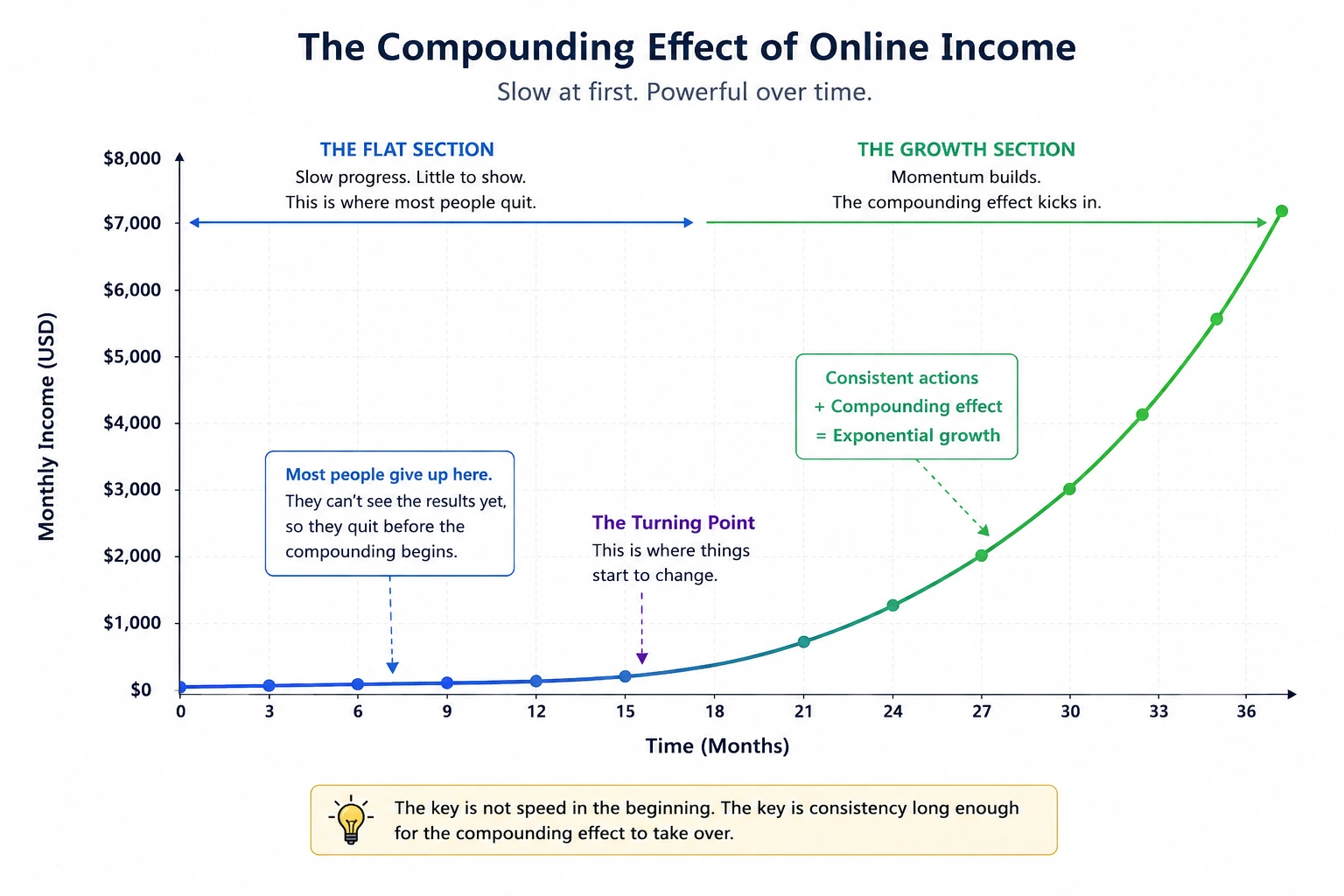
The reason is that the early phase of compounding produces growth that is happening at a scale too small to feel significant, even when the percentage rate of growth is actually very high.
Going from 34 visitors to 61 visitors is 79% growth. Most businesses would celebrate 79% monthly growth. But 34 to 61 is an increase of 27 people, which is easy to dismiss as noise rather than a signal when you’re expecting thousands.
Going from $4.70 to $12 in affiliate commissions is 155% growth. Again, genuinely remarkable growth by percentage. As a dollar amount, it feels like the method is not working.
This is the specific optical illusion of the compounding curve. The percentages look good from very early on. The absolute numbers don’t look like anything until the base they’re growing from becomes large enough to make the percentage feel real.
There is also a lag between effort and visible output in content-based online income that makes the flat phase feel longer than it is. An article published today will not reach its ranking peak for four to eight months, depending on the domain’s authority and the competition in the keyword space.
The work is done today. The output appears later. When you are in month two and the articles from month one are still climbing toward their eventual ranking positions, the gap between effort and reward is wide enough that the compounding is genuinely invisible.
This is not a flaw in the system. It is how the system works. But knowing it intellectually and feeling it while you are inside it are two different experiences, and most guides about compounding skip the part about how it actually feels to be inside the flat phase.
The Three Stages Every Compounding Online Income Goes Through
Understanding the three distinct stages helps you identify which one you are in right now, which changes how you interpret your current results.
Stage One: The Foundation Phase (Months One Through Six in Most Content Models)
This is the phase that feels like nothing is happening.
You’re putting in the work, publishing the content, and moving forward. The challenge is that traffic and income often remain small for a while, making meaningful growth harder to notice than it actually is.
What is actually happening during Stage One: domain authority is being established, articles are being indexed and slowly climbing search result positions, the email list is collecting its earliest subscribers, and the pattern of consistent publishing is being established. None of these produces income directly. All of them are necessary preconditions for Stage Two.
The analogy I keep returning to is a flywheel. A heavy flywheel requires enormous effort to get moving. The first push barely moves it. The second push barely moves it. The tenth push barely moves it. But somewhere around push forty, the flywheel is moving under its own momentum, and every subsequent push produces noticeably more rotation than the push before it.
Stage One is pushing a flywheel. The rotation is real. It just isn’t dramatic yet.
Stage Two: The Emergence Phase (Months Six Through Twelve in Most Content Models)
This is the phase where the compounding first becomes visible.
Articles start to rank on page two and page one for longer-tail variations of their target keywords. Organic traffic begins to grow in a way that feels meaningful rather than statistical noise. The email list, if it has been built consistently, starts to contain enough subscribers that an affiliate recommendation occasionally converts. A freelancer’s referral network starts to produce inbound enquiries rather than requiring all outreach to be outbound.
The emergence phase is encouraging, but it is also fragile. This is the moment where a change in strategy, a pivot to a new niche, or a period of inconsistency can reset the compounding progress that has been building. The flywheel is turning, but it has not yet built enough momentum to survive disruption.
Stage Two requires the same consistency as Stage One, with the added discipline of not over-correcting based on the partial data the emergence phase provides.
Stage Three: The Acceleration Phase (Months Twelve and Beyond in Most Content Models)
This is the phase that income reports describe.
The content library is large enough that new articles benefit from immediate internal link equity. The domain authority is established enough that new content ranks faster than earlier content did. The email list is warm enough and large enough that recommendations produce meaningful commission income. The freelancer’s reputation produces referrals that reduce or eliminate the need for cold pitching.
The specific characteristic of Stage Three is that the same effort that was invisible in Stage One is now visibly productive. An article that would have taken six months to rank in Stage One ranks in three weeks in Stage Three because the domain it lives on has been earning authority for twelve months.
This is what compounding looks like when it has had enough time to build.
What Compounding Looks Like for a Blogger and Affiliate Marketer
Let me be specific about the content compounding model because it is the one most beginners are pursuing and the one where the compounding effect is most misunderstood.
An article published in month one of a new blog goes live on a domain with minimal authority and no established topical relevance signal. It might rank on page eight for its target keyword. It might attract 15 organic visitors in its first month. This feels like failure.
Three months later, that same article has accumulated some time in the index. The domain has published 12 more articles. Internal links from newer articles have pointed back to the original. It has climbed to page four. It attracts 60 organic visitors per month. Still modest. Still feels slow.
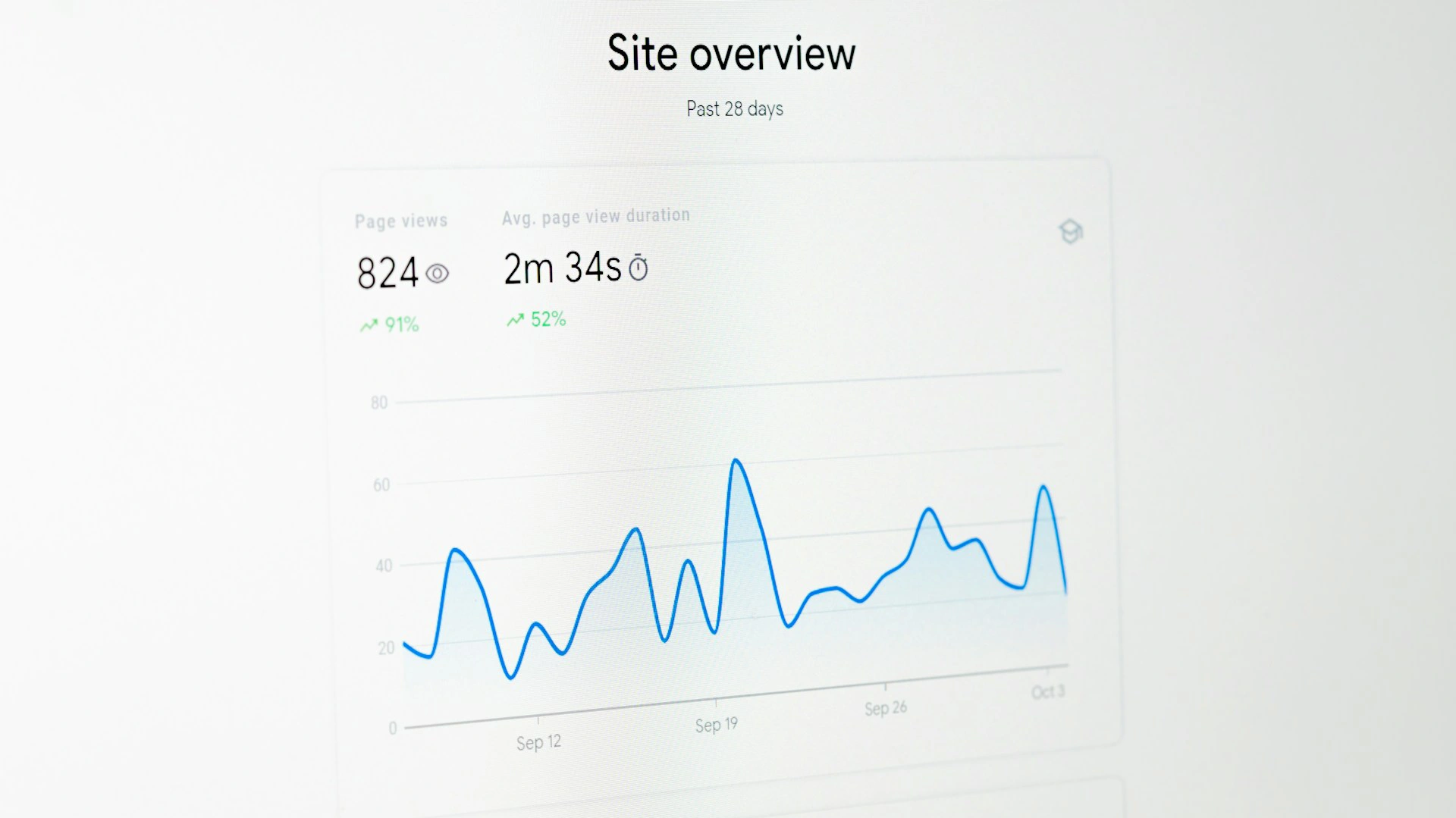
Six months later, the domain has 24 articles establishing topical authority in its niche. The original article has climbed to page two. It attracts 280 visitors per month and generates two or three affiliate commission clicks per week. The income from it is still small, but the trajectory is clear.
Twelve months later, the article is page one for its primary keyword and ranking for dozens of related longer-tail searches it was never specifically optimised for. It attracts 1,800 visitors per month and generates consistent affiliate commissions every week. The article that felt like a failure in month one has become a significant income asset, and no additional work was done to it after the initial publication.
This is content compounding. One article, one effort investment, accelerating output over twelve months. Check out: How to Write Blog Posts That Rank on Google: A Step-by-Step Guide for Beginners
Now multiply that by 48 articles published consistently over that same twelve-month period, each at a different stage of its own compounding trajectory, and the aggregate income picture changes dramatically from what any individual article suggests in its first three months.
Semrush is the tool that helps you target the right keywords from the beginning of this process, which determines how steeply the compounding curve rises. Content written around keywords with genuine search volume and realistic ranking competition starts compounding faster than content written without that research layer.
GravityWrite is worth knowing specifically for the production side of this model, because the volume of content that compounding rewards requires a publishing pace that is difficult to maintain without assistance on the drafting and structuring phase.
Check out:
- How to Earn Extra Income Online with Affiliate Marketing
- How Bloggers Make Money Online (And What the Real Income Numbers Actually Look Like)
Not Sure What’s Holding Your Blog Back?
Sometimes growth takes time. Other times, hidden SEO, content, monetization, or AI visibility issues are slowing your progress. My Blog Growth Audit helps identify what’s working, what’s not, and where your biggest growth opportunities are. Get a Blog Growth Audit →
What Compounding Looks Like for a Freelancer or Service Provider
The compounding mechanism in freelancing is less discussed but equally real, and it operates through a different set of inputs than content compounding.
A freelancer in month one has no testimonials, no referred clients, and no reputation in any specific niche. Every client they land comes from a cold proposal or a platform search result. The conversion rate on outreach is low because every potential client is making a judgment with no social proof to support the decision.
A freelancer in month twelve has a different profile entirely. They have testimonials from clients who were genuinely happy with the work. They have been referred by two or three previous clients to people in their network. Their name has appeared in conversations they were not part of. Their Upwork profile has a job success score and a review history that new potential clients can evaluate.
The work required to land a new client in month twelve is significantly less than the work required to land the same value client in month one, because the accumulated evidence of quality does part of the selling before the freelancer writes a single word of a proposal.
This is reputation compounding. The trust that each completed project builds does not disappear when the project ends. It accumulates in the form of social proof that reduces friction for every subsequent opportunity.
The specific compounding accelerator in freelancing is specialisation within a niche. A freelancer who establishes themselves as the person in a specific community or industry for a specific type of work benefits from a more concentrated reputation than a generalist. Word of mouth travels faster in specific communities than it does across broad, undefined markets.
Recommended Reading:
- How to Start Freelancing With No Experience (Step-by-Step Guide)
- How to Write a Freelance Profile That Gets Clients
- How Long Does It Take to Earn Your First $100 Freelancing? (Honest Answer)
- Best Freelance Niches for Beginners: Which One Should You Actually Choose?
What Compounding Looks Like for an Email Newsletter
The email list is the compounding asset that most beginners undervalue at the beginning and wish they had started earlier at the end, and its specific compounding mechanism is worth explaining in its own section.
An email list of 50 subscribers is worth a different amount per subscriber than an email list of 5,000 subscribers, even if the 50 subscribers and the 5,000 subscribers were acquired through identical methods and joined for identical reasons.
Here is why…
Trust is built through repetition. A subscriber who has received 40 consistently helpful, genuine, no-ask emails from you has developed a relationship with your voice and your recommendations that a subscriber who joined last week has not. When you make an affiliate recommendation to the subscriber who has been with you for eight months, they already trust you as a source. The recommendation carries the full weight of eight months of earned credibility.
The same recommendation made to a brand-new subscriber converts at a fraction of the rate, not because the recommendation is worse, but because the trust account has not been filled yet.
This means the income per subscriber from your list increases over time without you doing anything different, simply because time passes and consistent sending fills the trust account of every subscriber who stays.
Beehiiv is the newsletter platform I would recommend for building this kind of trust-based email asset from the beginning. Its free plan handles everything a growing list needs in the early compounding phase, and its interface makes consistent weekly sending genuinely manageable for someone building a newsletter alongside other income activities.
The referral and recommendation tools built into Beehiiv also accelerate subscriber compounding specifically. Existing subscribers who share your newsletter with their networks bring new subscribers who are pre-qualified by the recommendation, meaning they are more likely to stay and become the kind of long-term subscribers who eventually convert on affiliate recommendations.
See also: How to Start Building an Email List From Zero (And Why You Should Start Today)
The Specific Moment Most Beginners Quit — And What They Miss
I want to be precise about this because the timing matters more than most guides acknowledge.
The most common quitting point in content-based online income building is between months three and five. And the reason this timing is so damaging is that months three through five are almost universally inside Stage One, the foundation phase, where the compounding is happening entirely beneath the surface.
The work done in months one through three is not wasted if you quit in month four. But it becomes wasted in a very specific way. The domain authority built during those months was being accumulated on the way to a threshold where it would have started to express itself in rankings and traffic. When you abandon the domain, that authority is still there, but it is not being added to, which means it erodes over time rather than crossing the threshold.
It is like filling a bathtub that has a very slow drain. You have been filling it for three months. The water level is rising but slowly. You decide the tub might be broken and you stop filling it. The drain, which was always there, slowly empties everything you had accumulated. You will never see the water overflow.
The people who describe their online income as “exponential growth” are almost universally people who pushed through month three through month five without quitting, which is the only way anyone ever discovers what month seven looks like.
I have never spoken to or read about someone who stayed consistent through twelve months of a legitimate content strategy and then reported that the compounding didn’t happen. The failures I have encountered consistently involve stopping between months three and six, which is before the shape of the curve becomes visible.
How to Know If Your Work Is Compounding Before You Can See It in Your Income
This is the section I wish someone had given me during my own slow phase, because the absence of income is not the same as the absence of compounding progress.
Here are the specific non-income signals that compounding is happening even when income hasn’t arrived yet.
Your content is getting indexed faster than it used to. In month one, a new article might take two to three weeks to appear in Google’s search results. By month six, new articles from an active domain typically appear within one to three days. Faster indexing is a domain authority signal. It means Google has recognised your site as a regular, reliable publisher worth crawling frequently.
Earlier content is ranking for terms you didn’t target. When articles begin ranking for related keywords and question phrases that you didn’t specifically optimise for, that is a signal of growing topical authority. The domain is being recognised as a relevant source in its niche, not just for individual keywords. This is a compounding signal that predates income.
Your email open rates are holding or improving as the list grows. A list that maintains a 40% open rate as it grows from 80 subscribers to 300 is building the kind of engaged audience that converts on recommendations. Falling open rates in a growing list signal the opposite. Stable or rising rates signal the trust compounding that precedes income.
Inbound client enquiries start appearing alongside outbound pitching. A freelancer who was doing all cold outreach in month two and now receives one or two inbound enquiries per month in month seven without doing anything specifically different is experiencing reputation compounding. The word about their work is spreading through channels they are not directly managing.
People are sharing or referencing your content without you asking. When another creator links to your article, when a reader shares it in a community you are not a member of, or when someone quotes your newsletter in their own newsletter, these are compounding signals. Your content is earning credibility in communities beyond the ones you are directly building.
All of these signals precede income. They are the evidence that the flywheel is turning before it is turning fast enough to feel dramatic.
The Tools That Accelerate Compounding Without Shortcutting It
Something worth saying plainly: no tool shortcuts the time that compounding requires. The three-stage process has a minimum timeline that effort and tools can affect but cannot eliminate.
What the right tools do is increase the quality and consistency of input during each stage, which affects how steeply the curve rises when it eventually does.
Semrush accelerates content compounding specifically by helping you target keywords that have genuine search volume and realistic ranking potential. Content written around the right keywords compounds differently than content written without research, because the right keyword means the article is being shown to people who are actively searching for exactly what it covers.
GravityWrite accelerates the volume and consistency of content production, which is the specific input that content compounding rewards most directly. More high-quality articles, published more consistently, compound faster than fewer articles published sporadically. GravityWrite helps you maintain the publishing pace that compounding requires without the blank-page friction that causes inconsistency.
Beehiiv accelerates email list compounding by making consistent weekly sending manageable and by providing built-in tools for subscriber referrals and newsletter recommendations that grow the list through word of mouth rather than only through your own direct promotion.
Hostinger is the foundation tool that affects compounding indirectly but significantly. A properly set-up domain and hosting plan on a fast, reliable server affects site speed, indexability, and the professional credibility that helps content earn backlinks. The technical foundation is where compounding for content sites starts.
Systeme.io accelerates the email list compounding cycle by automating the welcome sequence and follow-up emails that build the relationship with new subscribers during their most important early weeks on your list. A new subscriber who receives five excellent automated emails in their first two weeks develops trust faster than one who receives nothing until the next manual newsletter.
How to Protect Your Compounding Progress During the Slow Phase
The flat phase of the compounding curve is the most dangerous period in online income building because it produces the most doubt with the least visible justification for staying.
Here are the specific strategies that help you protect the progress you are making when you cannot yet see it in your income.
Track non-income metrics weekly, not income. During Stage One, income is the wrong metric to watch because it is genuinely near zero and will stay there until the foundation is sufficient. Tracking organic sessions, keyword ranking improvements, email subscriber count, proposal response rate, and inbound enquiry frequency tells you a much more accurate story about whether compounding is happening than your affiliate dashboard does in month four.
Set a minimum commitment date and write it down before motivation gets hard. Decide now, while you are reading this and feeling clear, that you will not make any strategic changes before a specific date at least six months from today. Write that date somewhere you will see it. Decisions made during the flat phase without a pre-committed minimum tend to terminate compounding at exactly the wrong moment.
Study the shape of the curve for people in your specific model. Find bloggers or creators who have documented their early traffic and income numbers publicly, not just their successful months. Understanding that month three of a blog typically looks like X and month nine typically looks like Y gives you a reference point for where your own numbers should sit, which reduces the sense that your specific results are unusually bad.
Connect with others at a similar stage. The compounding phase is easier to survive in a community of people going through the same experience simultaneously. Online communities, forums, and accountability groups for beginners in your specific income model provide both information and the specific emotional resource of knowing that what you are experiencing is normal rather than evidence of failure.
The First Dollar Blueprint is structured around exactly this principle. Having a clear, specific task for each of the first seven days removes the ambiguity that makes the flat phase feel unproductive, and producing real output from day one creates the kind of early evidence of progress that helps you trust the process during the months that follow.
Key Takeaways
The compounding effect of online income is real, predictable, and nearly invisible during the phase when the foundation is being built. Understanding the shape of the curve before you experience the slow phase changes your interpretation of the slow phase entirely.
Most beginners quit during Stage One, which is the foundation phase, before any of the compounding they have been building has a chance to express itself in income. The quitting moment and the turning point are often separated by a few weeks of additional consistent work.
Non-income metrics tell a more accurate story than income during the early compounding phase. Indexing speed, keyword position improvements, email list growth, and inbound enquiry rate are all evidence of compounding before the income catches up to the underlying progress.
The tools that matter most for compounding are the ones that support consistency and quality over the long timeline that compounding requires. No tool shortcuts the time. The right tools make it easier to produce the consistent, quality input that compounding rewards.
Conclusion
The compounding effect of online income is the most important concept in this space that almost no beginner understands at the moment they most need to understand it.
Not because it’s complex. Because it is genuinely invisible from the inside during the phase when its implications are most practically important.
You are probably somewhere in Stage One right now. Working consistently, seeing minimal visible return, wondering if the method is broken or if you are uniquely bad at this. The answer is almost certainly no to both.
What you are almost certainly doing is filling the bathtub with the drain running slow. The water is rising. You cannot see how close to the edge it is because you are too close to the water level to see the rim.
What changed my own understanding of this was looking at my traffic data over eight months side by side rather than one month at a time. The shape that had been invisible in the individual months was unmistakable in the aggregate.
Your curve is already forming. The question is not whether compounding works. It is whether you will be there when it does.
Keep publishing. Keep pitching. Keep sending. Keep building. The acceleration does not announce itself in advance. It just arrives one month when you check your numbers and realise something has shifted.
The First Dollar Blueprint gives you the structure for the earliest phase of that building process, one specific task per day for seven days, so the first week of compounding work happens with clarity rather than guesswork.
Frequently Asked Questions
What is the compounding effect of online income and how does it work?
The compounding effect of online income is the process by which each unit of effort you invest today produces progressively more income over time without additional effort on that specific unit. A blog article published today earns at a modest rate in its first month, a higher rate in month six as it ranks for more keywords, and a higher rate again in month twelve as the domain around it has built authority. The income from that single article grows without the article being rewritten, because the infrastructure around it, domain authority, internal links, backlinks, and topical relevance, accumulates over time.
Why does online income grow so slowly at the beginning?
Online income grows slowly at the beginning because the compounding inputs, domain authority, subscriber trust, professional reputation, and content library depth, require time to accumulate to a threshold where they produce visible output. An article on a new domain ranks slowly because the domain has not yet established trust with search engines. An email list of 50 subscribers converts at a lower absolute rate than a list of 2,000, even with identical percentage engagement, because the absolute numbers are too small to produce meaningful income even when the percentage metrics are healthy. The slow beginning is the foundation phase of the compounding curve, not evidence that the method is broken.
How long does it take for online income to start compounding noticeably?
For content-based models like blogging and affiliate marketing, most creators notice the beginning of Stage Two, the emergence phase, somewhere between months six and twelve of consistent publishing. For email newsletters, meaningful compounding from subscriber trust typically becomes noticeable around months four through eight of consistent weekly sending. For freelancers, reputation compounding becomes noticeable when inbound referrals start supplementing or replacing outbound pitching, which typically happens somewhere in months six through twelve of active, consistent client work. These timelines vary based on niche, content quality, and consistency, but they represent the realistic range rather than the outlier cases.
How do I know if my online income is compounding even when I can’t see it in my earnings?
Several non-income metrics indicate that compounding is happening before it appears in your income numbers. Your content is being indexed faster than it was in your first month, which signals growing domain authority. Earlier articles are ranking for related keywords you did not specifically target, which signals topical authority development. Your email open rate is holding or improving as the list grows, which signals trust building. Inbound enquiries or referrals are supplementing your outbound efforts in freelancing, which signals reputation accumulation. These signals consistently precede the income acceleration by several months and are more accurate indicators of underlying progress than income alone.
Is it possible to speed up the compounding effect of online income?
The timeline of compounding cannot be eliminated, but it can be shortened by increasing the quality and consistency of input during each stage. Publishing higher-quality, better-researched content more consistently accelerates content compounding. Using keyword research tools to target the right topics accelerates the ranking trajectory. Building an email list from day one accelerates the trust compounding that makes recommendations convert. Building in a specific niche rather than broadly accelerates the reputation compounding that produces freelance referrals. These choices do not shortcut the process, but they affect how steeply the curve rises when the acceleration phase begins.
What is the biggest threat to compounding progress during the slow phase?
The biggest threat is strategic inconsistency, specifically changing methods, switching platforms, or abandoning the current approach before the compounding has had enough time to produce visible results. Every time a beginner starts a new blog, changes their niche, switches from content to services, or moves from one social platform to another, the compounding progress on the previous path is either abandoned or severely disrupted. The compounding that had been accumulating over months does not transfer to the new path. It stays on the old one, which has now been abandoned. The compounding curve starts over at zero on the new path. This is the specific cost of strategic inconsistency during the flat phase and why protecting the commitment to the chosen approach through the slow months is the single most important factor in whether compounding eventually accelerates.