Online Job vs Online Business: A Clear Breakdown of How Each One Works

Online jobs vs online business. Most beginners use these terms interchangeably, and it costs them. This honest breakdown explains the real difference, with specific examples and which path fits your current situation.

People use these terms as if they mean the same thing. They don’t.
I have had people tell me they’re “running an online business” when what they’re describing is a Fiverr profile they log into to check for orders. I’ve also spoken to people who dismissed their blog as “just a side project” when it was quietly generating $800 a month in affiliate commissions without them actively working on it.
The distinction between an online job and an online business isn’t just semantic. It changes how you think about your time, your income ceiling, your financial security, and your long-term strategy.
Getting this wrong leads people to build the wrong thing entirely, then wonder why their income disappeared when they stopped working.
This article explains the real difference, not the textbook version. With specific examples, honest trade-offs, and a clear framework for deciding which path fits where you are right now.
TL;DR
- An online job pays you for your time and effort. When you stop, the income stops.
- An online business generates income from an asset you’ve built. Done right, it earns beyond your active hours.
- Most beginners should start with an online job for immediate income, then transition to building a business using that income and experience.
- The “passive income” version of an online business takes longer to build than most guides admit, but the ceiling is significantly higher.
Ready to Build Your First Online Income?
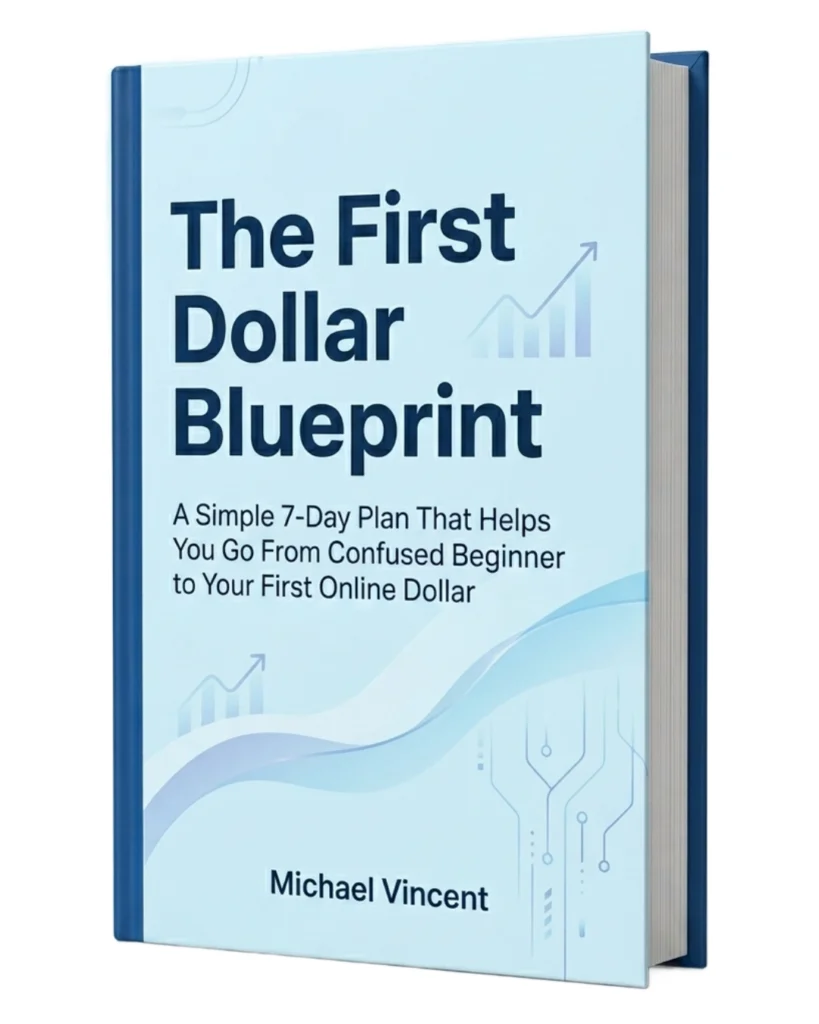
If you’re serious about moving from learning to earning, The First Dollar Blueprint gives you a clear 7-day action plan to follow. It’s designed for complete beginners with no experience, no special skills, and no startup money required. Instead of wondering what to do next, you’ll know exactly which steps to take each day.
Online Job vs Online Business: A Side-by-Side Comparison
| Factor | Online Job | Online Business |
|---|---|---|
| Income model | Active: paid for time, skill, or effort | Leveraged: income from an asset you built |
| Stops working? | Income stops the same day you stop | Income continues (or slows gradually) |
| Time to first income | Days to weeks | Months to a year or more |
| Income ceiling | Capped by your available hours and rates | Uncapped (scales with traffic, buyers, or audience) |
| Ownership | Client-dependent (lose clients, lose income) | Self-directed (you own the asset) |
| Scalability | Limited (you only have 24 hours in a day) | Expandable (blog, course, or list has no max) |
| Startup risk | Low (free platforms, immediate work) | Higher (longer build period, uncertain outcome) |
| Long-term resilience | Fragile (one client or platform change can end income) | Resilient (diversified traffic and income streams) |
| Time requirement over time | Always on (hours = dollars) | Front-loaded then increasingly independent |
| Example | Freelance writer, virtual assistant, tutor, transcriptionist | Affiliate blog, YouTube channel, email newsletter, digital course |
The One Question That Separates a Job From a Business
Here’s the clearest way I know to diagnose which one you have.
If you stopped working tomorrow, would income continue arriving?
If the answer is no, you have an online job. The income is tied directly to your active participation. Stop participating, stop earning.
If the answer is yes, or at least partially yes, you have an online business. Something you’ve built continues generating value, and therefore income, without requiring your continuous presence.
That’s the core distinction. Everything else follows from it.
A freelance writer who earns $3,000 per month writing articles for clients has an online job. Exceptionally well-paying. Fully flexible. Entirely legitimate. But if they stop writing, the $3,000 stops within the month.
A content creator who built a blog about personal finance that earns $3,000 per month through affiliate commissions and display advertising has an online business. The articles they wrote six months ago are still being found through Google search today, still generating clicks, still producing commissions, regardless of whether they published anything this week.
You see…same dollar amount. Completely different structure. Completely different future.
What an Online Job Actually Looks Like (With Real Examples)
An online job is any arrangement where your income is directly exchanged for your time, skill, or effort. The moment you stop providing those things, the income stops.
This includes more categories than most people realise.
Freelance writing: You write articles, blog posts, web copy, or email sequences for clients who pay you per piece or per hour. When you finish a piece and submit it, you get paid. When there are no pieces to write because you have no clients, or because you chose not to work this week, you earn nothing. This is an online job. A well-paid, flexible, skill-based online job, but a job.
Also check out: How to Get Your First Freelance Client Fast (Even With No Experience or Portfolio)
Virtual assistance: You manage tasks for business owners. Schedule appointments, handle emails, research topics, maintain social media calendars. You earn while you’re doing the work. Stop doing the work, the income stops…Job.
Transcription: You convert audio to text through platforms like Rev. You earn per audio minute transcribed. Take a week off, earn nothing that week. Job.
Tutoring on Cambly or Preply: You earn per session. No sessions, no earnings. Job.
Customer support for remote companies: You get paid an hourly or monthly salary to respond to customer enquiries. Classic employment structure, just delivered online rather than in an office. Very much a job.
Social media management for clients: You manage Instagram, Facebook, or LinkedIn accounts for businesses and get paid a monthly retainer. This sits close to a business in some ways, but if you lose your clients or stop delivering, the income stops immediately. In most cases, it functions as a job.
None of this is a criticism of online jobs. I want to be very much clear about that. Online jobs are often the smartest starting point for beginners because they generate income immediately without requiring months of upfront investment. The income is real, the clients are real, and the skills you develop are directly applicable to everything that comes later.
But calling a freelance arrangement a “business” when it’s actually a job creates a false sense of security. You think you’ve built something when what you’ve actually built is a set of client relationships that need constant maintenance to produce income.
Recommended: Freelance Skills That Pay Well Online (Even If You’re Starting From Zero)
What an Online Business Actually Looks Like (With Real Examples)
An online business generates income from an asset. The asset is something you build, and once it’s built to a functional level, it produces income independently of your daily participation.
The keyword is asset. Not a service you provide. Not the time you trade. Just an asset.
A blog with affiliate marketing: You write articles that rank on Google. Readers find those articles by searching for information or product recommendations. Your affiliate links, embedded naturally within helpful content, generate commissions when readers click through and buy.
An article you wrote eight months ago about the best email marketing tools for beginners is still being found today, still driving clicks, still earning commissions. You wrote it once. It works indefinitely. That’s an asset.
A YouTube channel: You create videos that live on the platform permanently. A tutorial you uploaded two years ago might be getting its highest ever view count right now because YouTube’s algorithm decided to recommend it. Ad revenue arrives from views on old videos. Affiliate links in descriptions earn from traffic on content you don’t actively promote. Asset.
An email newsletter with a paying audience: You’ve spent twelve months growing a newsletter to 4,000 subscribers. When you release a sponsored email or recommend an affiliate product to that list, you earn based on the audience you’ve built, not based on hours worked that day. The list is the asset.
A digital course: You spend three months creating a comprehensive course on a topic you know well. You host it on a platform like Teachable or through Systeme.io and drive traffic to it through your blog or social media. Someone discovers it at 2am, buys it, and the income shows up in your account while you’re asleep. The course is the asset.
An affiliate website in a niche: A site specifically built around reviewing and comparing products in a single niche, photography equipment, accounting software for freelancers, and home gym gear. You build the content library over six to twelve months. Traffic accumulates through search. Affiliate commissions arrive from visitors finding the site organically. The site is the asset.
Recommended: Best Affiliate Programs for Beginners in 2026 (No Big Audience Required)
What these examples share is that the income continues even when you’re not actively working. Not necessarily forever without maintenance, we’ll talk about that shortly. But with meaningful independence from your daily presence.
The Six Real Differences Between an Online Job and an Online Business
Now let’s get practical.
Many people think an online job and an online business are basically the same thing because both can be run from a laptop. But once you look at how money is earned, how growth happens, and what you’re actually building, the differences become much easier to see.
1. Income Model: You Earn From Work vs You Earn From Assets
The biggest difference is where the money comes from.
With an online job, you get paid because you completed a task or spent time working. If you’re a freelance writer, a virtual assistant, or a graphic designer, someone pays you for the work you personally deliver.
An online business works differently. Instead of being paid directly for your time, you’re building something that can keep creating value after the work is done. That could be a blog post, a YouTube video, a digital product, an email newsletter, or an affiliate website.
For example, a writer who charges $100 per article earns $100 once. A blogger who writes a helpful article that ranks on Google might continue earning affiliate commissions from that same article months or even years later.
The first model pays for effort. The second model pays for assets.
2. Scalability: More Work vs More Reach
When you have an online job, growth usually means doing more work.
You take on more clients, complete more projects, or work more hours. You can certainly increase your income, but eventually you run into practical limits. There are only so many hours in a day, and there is only so much work one person can handle.
An online business can grow without requiring the same increase in effort.
A blog can go from 100 visitors a month to 100,000 visitors a month. A digital product can be sold once or sold ten thousand times. A YouTube video can be watched by ten people or ten million people.
The work required to create the asset doesn’t increase at the same rate as the audience consuming it.
That’s why businesses often have much greater long-term earning potential.
3. Ownership: Renting Income vs Building Something You Own
This is one of the most overlooked differences.
When you’re working an online job, your income often depends on other people. Freelancers depend on clients. Remote employees depend on employers. If those relationships end, the income usually ends too.
With an online business, you’re building assets that belong to you.
Your website is yours. Your email list is yours. Your content is yours. Your digital products are yours.
That ownership creates more control over your future income because you’re not relying on a single client or contract to keep money coming in.
4. Income Ceiling: Limited Growth vs Open-Ended Growth
Online jobs can be very profitable, but they usually have a natural ceiling.
Imagine a freelance writer charging $200 per article. If they write ten articles per week, they earn $2,000. To earn significantly more, they either need to charge higher rates or find more time to work.
At some point, there are limits.
An online business doesn’t have the same kind of ceiling because income isn’t tied directly to hours worked.
A successful blog can keep attracting new visitors. An affiliate website can keep generating commissions. A course can keep selling. Growth depends more on demand, traffic, and audience size than on the number of hours worked each week.
5. Time Requirement: Constant Work vs Front-Loaded Work
An online job usually requires your ongoing involvement.
If you stop working, the income often stops too. That’s not necessarily a bad thing. Many freelancers earn excellent money this way. But there is a direct connection between work and income.
An online business often requires more work at the beginning.
You spend time creating content, building systems, growing an audience, or developing products. The early stages can actually feel slower and harder than freelancing.
The difference is that the work you do today can continue producing results tomorrow.
Over time, each asset you build has the potential to keep working long after it was created.
6. Risk Profile: Faster Start vs Stronger Foundation
An online job is usually easier to start.
You can learn a skill, find clients, and begin earning relatively quickly. That’s one reason freelancing is such a popular starting point for beginners.
The downside is that your income can be vulnerable. Losing a major client or contract can have an immediate impact.
An online business often takes longer to get off the ground.
There may be weeks or months where you’re building without seeing much financial return. That can feel uncomfortable, especially for beginners.
But once the business gains momentum, it often becomes more resilient because income is coming from multiple sources, assets, customers, or traffic channels rather than one client or employer.
At the end of the day, neither path is automatically better.
An online job is often the fastest way to start earning online. An online business is often the best way to build long-term income and ownership.
The smartest approach for many beginners is not choosing one or the other. It’s using an online job to create cash flow while slowly building an online business in the background. That’s exactly how many successful online entrepreneurs got started.
The Grey Area Nobody Talks About
At this point, it might sound like online jobs and online businesses sit on opposite sides of a fence.
In reality, most people spend a long time somewhere in the middle.
That’s the part most comparison articles leave out.
The truth is that many online income streams start as jobs and slowly evolve into businesses. Others start as businesses but still require enough day-to-day work that they feel a lot like jobs.
Take Fiverr as an example.
A brand-new Fiverr seller is essentially creating an online job. They need to find clients, build reviews, and complete work before they get paid.
But what happens after a few years?
Imagine a seller with hundreds of positive reviews, a top-rated badge, and a strong reputation in a profitable niche. At that point, clients often come directly to them. New enquiries arrive without constant pitching, and their profile starts generating opportunities on its own.
They still need to do the work, so technically it’s a job. But the profile itself has become an asset. It’s helping generate business even when they’re not actively looking for clients.
Freelancing often works the same way.
A freelance writer might spend their mornings working for clients while using evenings to build a newsletter, blog, or YouTube channel around their expertise. One side generates immediate income, while the other is building something for the future.
Over time, that audience becomes an asset.
The client work pays the bills today. The audience creates opportunities tomorrow.
Blogging creates another interesting example.
Let’s say someone spends six months building a website and publishing helpful content. Eventually, the site starts attracting traffic and earning affiliate commissions.
Then life gets busy.
They stop publishing new articles altogether.
Even though they’re no longer actively working on the site, traffic continues arriving and commissions continue coming in. The blog might earn a few hundred dollars each month long after the last article was published.
That’s clearly closer to a business than a job.
At the same time, it would be misleading to call it completely passive because eventually the content will age, competitors will publish newer information, and traffic may start declining if the site isn’t maintained.
Check out:
1. How to Start a Blog and Make Money for Beginners: A Complete Step-by-Step Guide
2. How Bloggers Make Money Online (And What the Real Income Numbers Actually Look Like)
Digital products sit in a similar grey area.
Someone might sell templates, ebooks, or online courses and technically own a business asset. Yet they still spend hours every week answering customer questions, updating materials, handling support requests, and promoting their products.
From the outside, it looks passive.
From the inside, there’s still plenty of work happening.
This is why I don’t think the goal should be to obsess over labels.
The more useful question is this:
Are you building assets alongside your income?
If all of your income disappears the moment you stop working, you’re operating closer to the online job side of the spectrum.
If some of your income continues arriving because of content, products, audiences, websites, or systems you’ve already built, you’re moving toward the business side.
Most successful people online don’t jump straight from employee to business owner overnight. They spend months or years operating somewhere in the middle, using active income to fund the creation of assets that eventually give them more freedom.
Understanding where you currently sit on that spectrum can help you make smarter decisions about where your next hour should go. Sometimes the best investment isn’t earning another dollar today. It’s building something that can keep earning tomorrow.
The Passive Income Myth Around Online Businesses

I think this is one of the most important things beginners need to understand before they choose an online business path.
The term passive income gets thrown around so often online that many people start believing they can build a website, publish a few articles, upload a digital product, and then watch money appear in their account while they do nothing.
That’s not how it works.
Most of what people call passive income starts out as very active income.
Take blogging as an example.
When someone sees a blog earning a few thousand dollars per month through affiliate marketing, they’re usually seeing the result of months or years of work that happened beforehand. What they don’t see are the hours spent researching topics, writing content, learning SEO, updating articles, building internal links, and figuring out what readers actually need.
For a long time, the blog feels anything but passive.
The interesting part happens later.
As more articles get indexed, traffic starts growing, and content begins ranking in search results, the effort required to maintain that income becomes smaller than the effort required to create it. Instead of spending twenty or thirty hours every week building the site, you might only spend a few hours updating content and keeping things running smoothly.
The income isn’t passive because no work was involved. It’s passive because much of the work happened earlier.
Digital products work the same way.
People love saying things like “sell while you sleep,” and technically that’s true. A customer can buy an ebook, template, or course at any hour of the day without you being present.
What often gets left out is everything that happens before and after the sale.
Someone still has to create the product. Someone has to write the sales page. Someone has to answer customer questions, process feedback, make improvements, and occasionally update the product so it stays useful and more relevant
The income becomes more flexible, but the business doesn’t completely run itself.
The same pattern appears with YouTube channels, newsletters, affiliate websites, and almost every other online business model you’ll come across.
The early stages require a lot of effort with very little reward. Then, if you stay consistent long enough, you reach a point where previous work continues producing results.
That’s what makes online businesses attractive.
Not because they’re effortless.
Because the relationship between time and income starts changing.
With a traditional job, today’s income usually depends on today’s work. With a business asset, today’s income may partly come from work you completed six months ago.
That’s a powerful difference.
So when people ask me whether passive income is real, my answer is usually yes—but not in the way it’s often advertised.
The honest version of passive income is income generated from assets you’ve already built, where the ongoing maintenance is much smaller than the original effort required to create them.
That may not sound as exciting as the promises you see in online ads, but it’s actually much better. It’s realistic, sustainable, and something ordinary people can build if they’re willing to be patient long enough for the work to compound.
Read: 5 Easy Passive Income Ideas for Beginners With No Money
Which One Should a Beginner Start With?
My honest answer, based on everything I’ve seen and built myself, is to start with an online job and build toward an online business.
Here’s the reasoning.
An online job generates income within weeks for most people who apply consistently. That income does several important things simultaneously.
It covers your current expenses without requiring debt or dipping into savings. It gives you real-world experience with online platforms, client communication, and digital workflows. And it teaches you which topics, skills, and niches you’re genuinely interested in, which is the information you need to build the right online business later.
Building an online business first without any income coming in, creates a financial pressure that makes it very hard to be patient with a slow build. Most people quit too early because the money isn’t arriving fast enough, and they have real expenses that need covering.
The sequence that works for most people:
Start with an online job in a skill area that overlaps with a niche you’re genuinely interested in. A writer who takes on clients in the personal finance space is simultaneously earning income and developing expertise in a niche with strong affiliate marketing potential.
A social media manager working with wellness brands is building platform skills and niche knowledge in an area with profitable digital product opportunities.
Once the job income is covering your expenses comfortably, redirect a portion of your time toward building a business asset. A blog. An email newsletter. A digital product. The job funds the building phase. The asset eventually replaces the job’s income and exceeds it.
The First Dollar Blueprint maps out the first seven days of this journey with specific daily actions. Whether you’re starting with a job or trying to launch a business asset, having a clear starting framework removes the paralysis that stops most beginners before they ever earn a dollar.
Recommended Reading: How to Start a Side Hustle With No Money (7-Day Beginner Plan That Actually Works)
How to Transition From an Online Job to an Online Business
The transition is not an event. It’s a gradual shift that happens over months while you continue earning from your job.
Here is what it looks like in practice.
Step 1: Identify the niche your job work is already in.
If you’re a freelance writer covering financial topics, your online business is probably a personal finance blog. If you’re managing social media for e-commerce brands, your online business might be a YouTube channel or newsletter teaching other social media managers. Your job experience is research. Use it.
Step 2: Start building the asset while the job income runs.
Not instead of it. Alongside it. Ten to fifteen hours per week dedicated to the business build while the job continues covering expenses. This might mean three to four evenings per week and a few hours on weekends. The timeline is longer this way. The financial stability is better.
For a blog, start with Hostinger for hosting and a proper domain. A real domain from day one changes how seriously you approach the project and how seriously search engines and potential readers take it. The cost is manageable against even modest freelance income.
Step 3: Build your email list from the first day the business exists.
The email list is the connective tissue between your business asset and your income. Whether your business model is affiliate marketing, digital products, or sponsorships, the email list amplifies every monetisation strategy you use.
Beehiiv is the platform I’d recommend for this. The free plan is genuinely capable for a growing list and the newsletter format it supports builds the kind of reader relationship that converts into sales when you have something to recommend.
Step 4: Learn affiliate marketing as your first business monetisation.
Affiliate marketing fits naturally into content businesses because it monetises the content you’re already creating. Writing helpful articles about tools your readers need. Recommending products you’ve actually used. Earning commissions when readers buy. Check out: How to Start Affiliate Marketing for Beginners: A Complete Step-by-Step Guide

Want a Clear Affiliate Marketing System?
If you’re tired of hearing “create content and add affiliate links” without anyone explaining what happens next, The H.E.A.R.T Funnel Formula was built for you. It gives beginners a clear, repeatable framework for turning content into affiliate commissions and helps bridge the gap between simply posting online and building a real income-generating business.
Step 5: Build the funnel infrastructure as income grows.
Once affiliate commissions are arriving consistently, add the infrastructure that turns a content site into a real business. An email sequence that introduces new subscribers to your best content. A simple product offer. A landing page for something specific your audience wants.
Systeme.io handles all of this on a free plan. Email automations, simple sales pages, course hosting, and basic funnels without the complexity or cost of stitching together multiple separate tools.
What Happens When You Confuse the Two
This matters more practically than most people realise.
When you call a freelance income stream a “business,” you make different decisions than you should.
You don’t build the safety net that a job income requires, because businesses feel more resilient than they are at the early stage. You don’t invest in building a real asset because you already feel like you have one. And when a client leaves or a platform changes its terms, the income disappears faster than you expected because you weren’t treating it as the fragile job income it actually was.
I’ve seen this pattern play out with readers who built significant Fiverr or Upwork incomes and called them businesses. When Upwork changed its fee structure, or when a major client moved on, they found themselves effectively starting from scratch because they’d spent years working in their income rather than on building something that could outlast a single client relationship.
On the other side, I’ve seen people delay starting an online job because they were trying to build a “real business” from day one. They spent six months building a website that earned almost nothing while their savings drained. The business mindset was right. The timing was wrong. The income to fund the building period never materialised because they skipped the job phase entirely.
Both paths are real. Both require different thinking, different timelines, and different risk tolerance. Understanding which one you’re on is not just an intellectual exercise. It determines what decisions you should be making with your time, your money, and your expectations right now.
Conclusion
An online job and an online business are genuinely different things, and the difference is not about prestige or scale. It’s about structure.
An online job pays you for your participation. Stop participating, stop earning. It’s fast to start, relatively predictable, and the best way to generate income quickly when you need it.
An online business builds an asset that earns beyond your active hours. Slow to build, higher ceiling, and more resilient once it reaches a functional level. The front-loaded work is real. The long-term payoff is too.
Most people’s journey involves both. A job to create immediate income and fund the initial period. A business being built quietly on the side as the job continues. A gradual shift as the business starts contributing meaningfully. A point, somewhere in the twelve to thirty-six month range, where the business income makes the job optional rather than necessary.
That’s the honest arc. Not an overnight success. Not years of poverty before it works. A deliberate sequence of building the right thing at the right time.
Where are you in that sequence right now? If you’re not sure, start with the job. Build your first income. Then use what you learn to build something that works for you even when you’re not working.
The First Dollar Blueprint is where that starts.
Frequently Asked Questions: Online Job vs Online Business
What is the real difference between an online job and an online business?
An online job pays you in direct exchange for your time, skill, or effort. When you stop working, the income stops. An online business generates income from an asset you’ve built, like a blog, a digital course, a YouTube channel, or an email newsletter, that continues earning independently of your moment-to-moment participation.
The core diagnostic question is: if you stopped working tomorrow, would income continue arriving? If yes, you have a business. If no, you have a job. Both are legitimate income paths. They require completely different strategies and have completely different income ceilings and risk profiles.
Is freelancing an online job or an online business?
Freelancing is almost always an online job in its standard form. Your income depends directly on completing work for clients. If you take a two-week break, your income stops during those two weeks.
The exception is when a freelancer builds a team, creates systems that run without them, and generates client work through automated or evergreen lead generation rather than active pitching. At that point, it begins functioning more like a business. A solo freelancer with no team and no automated systems is in a job regardless of how much they earn or how professional their operation looks.
Which is better for beginners: starting an online job or building an online business?
For most beginners, starting with an online job is the smarter sequence. An online job generates income within weeks, covers current expenses, and provides real-world platform experience and niche knowledge.
A business, built correctly, requires a longer runway before producing meaningful income, typically six to eighteen months. Trying to build a business while under financial pressure to produce income quickly leads most people to quit before the asset reaches its earning potential. Start with a job. Fund the building period. Transition deliberately rather than abandoning the job prematurely.
Can an online job turn into an online business over time?
Yes, and this is actually one of the most natural and realistic transition paths available. A freelance writer who covers personal finance topics for clients can simultaneously build a personal finance blog, using their writing skills in a different format, that generates affiliate income independently.
A social media manager handling client accounts can build a YouTube channel or newsletter teaching social media strategy, monetised through courses and affiliate recommendations. The job provides income and niche expertise. The business is built from that expertise into an asset that eventually earns beyond the job’s ceiling.
What does passive income from an online business actually require?
Building a genuinely income-producing business asset typically requires six to eighteen months of consistent, non-passive work before the income becomes meaningfully independent of your active participation. A blog that earns $2,000 per month in affiliate commissions required consistent weekly content creation, SEO research, and community building for at least twelve months before reaching that level.
A digital course that sells regularly required months of creation, audience building, and marketing infrastructure before it ran with minimal daily attention. Passive income is more accurately described as income that requires significantly less active time per dollar than a traditional job, earned from an asset built through a front-loaded, intensive period.
How do I know when to stop focusing on my online job and focus on building a business?
A useful threshold is when your online job income consistently covers all your essential expenses with some margin remaining. At that point, you have the financial stability to invest time and small amounts of money into building a business asset without the pressure of needing it to produce income immediately.
Many people never fully stop the job, they simply reduce their client work gradually as the business income grows to compensate. The transition is rarely a single decision and more often a gradual rebalancing of time and energy as the business asset proves its earning potential.