How to Start Earning Online in 7 Days: A Step by Step Guide for Beginners

Learn how to start earning online in 7 days with simple, beginner-friendly steps. No experience needed. Start today.

I want to be upfront with you before we dive in.
This is not a “make $10,000 in your first week” post. Those posts exist to sell you something, and they do not work. What this post offers is something far more valuable: a clear, honest, day-by-day plan that gives you the best possible shot at earning your first dollar online within seven days.
That first dollar matters more than people realize. It is proof that the thing works. It breaks the mental block that keeps most people stuck at “thinking about it” for months. And once you have earned it once, you know exactly how to earn again.
Let’s build that proof, step by step.
Key Takeaways
- Picking one method and committing to it is more important than picking the perfect one.
- A clear, client-focused profile builds trust faster than a fancy website.
- Your first offer does not need to be perfect. It needs to be live and specific.
- Active outreach beats passive waiting every single time in the first week.
- Day six is where most people quit. It is also where the results are closest.
- Your first client review is more valuable than your first dollar. Protect it.
- The goal of week one is proof of concept, not financial independence.
What “Earning Online” Actually Looks Like for Beginners
Before the plan, a little context, because your expectations shape everything.
Most people imagine earning online looks like waking up to PayPal notifications. That is real for some people, eventually. In week one, it looks more like sending ten messages and hearing back from two. Landing one small job. Getting paid $20 or $50 for something you did in an afternoon.
That is not glamorous. But it is the foundation on which everything else gets built on.
Recommended Reading:
Why Most People Don’t Earn Online, and It’s Not What You Think
It is not a lack of skill. It is not bad luck. And it is definitely not that “all the good opportunities are gone.”
The real reason most people never earn a dollar online is simple: they never fully commit to one thing. They spend three days researching platforms, two days doubting their idea, and one day setting up a profile they never actually use. Then they give up and assume it does not work.
The plan in this post eliminates that spiral by giving you a single clear action every day. There is no room for endless research. Just focused on daily steps.
What You Actually Need to Get Started
A laptop or smartphone. An internet connection. A skill, or the willingness to do simple tasks that do not require one. And about one to two hours a day for seven days.
That is it. No website. No business registration. No startup capital. No special software. The barrier to your first dollar online is genuinely lower than most people think. The gap is almost always about action, not resources.
How to Start Earning Online in 7 Days
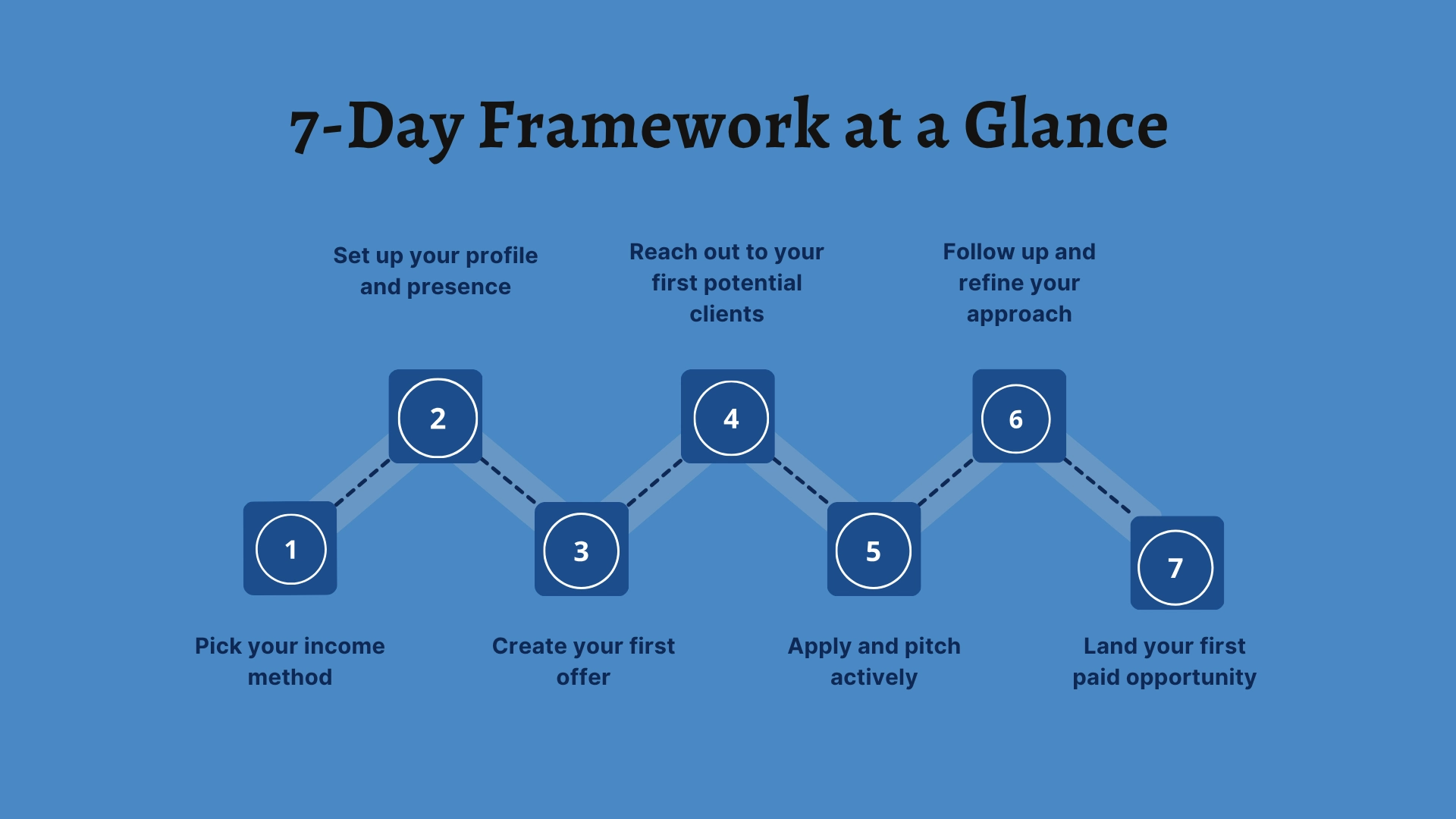
Day 1: Choose Your Online Income Method
This is the single most important thing you do this entire week. Pick one method. Not two. Not “I will try a few and see.” One.
Spreading across multiple methods in week one guarantees you will go deep on none of them and earn from zero of them. Focus is everything in the first seven days.
The Fastest Ways to Earn Online as a Total Beginner
Here are the methods most likely to produce income within seven days, ranked by how fast a complete beginner can realistically get paid.
Selling unused items online is actually the fastest path to cash for most people. List items you own but no longer use on Facebook Marketplace, eBay, Craigslist, or a local selling group. You can have money in your hand within 24 to 48 hours. No skill required.
Completing paid micro tasks: platforms like Amazon Mechanical Turk, Clickworker, and Respondent pay you to complete small tasks such as answering surveys, tagging data, testing websites, or participating in research studies. The pay per task is small, but you can start immediately with no profile or setup required.
Freelancing a skill you already have: writing, design, social media, data entry, video editing, tutoring, translation, virtual assistance. If you have any of these, you can create a profile on Fiverr or Upwork today and potentially have a client this week. This has the highest income ceiling of any beginner method.
Recommended Reading: How to Start Freelancing With No Experience
Online tutoring: if you are strong in any academic subject, a language, or even a practical skill like cooking or music, platforms like Preply and Superprof, or even direct posts on community Facebook groups, can get you your first student fast.
Virtual assistance: small business owners constantly need help with email management, scheduling, research, and admin tasks. This requires almost no technical skill and is surprisingly easy to land through direct outreach to small businesses in your area or network.
How to Choose the Right Method for Your Situation
Ask yourself two questions honestly.
Do I have a marketable skill right now? If yes, choose freelancing or tutoring. These pay more and build something long-term.
Do I need money as fast as possible with the skills I have today? If yes, choose selling items or micro tasks. This gets you faster cash but has a lower ceiling.
Pick the one that matches your actual situation. Not the one that sounds most exciting. Then commit to it for the rest of this week.
Day 2: Set Up Your Profile and Online Presence
You chose your method. Now you need a place for potential buyers or clients to find you and say yes to what you are offering.
This does not mean building a website. It means creating a profile on the right platform for your chosen method, and making sure that profile looks trustworthy to a complete stranger.
Platform Setup for Each Income Method
If you are freelancing, create a profile on Freelancer.com, Fiverr or Upwork. Fiverr lets clients find you through browsing. Upwork lets you apply to job postings. Both work for beginners. Just pick one to start with.
If you are tutoring, sign up for Cambly, Preply, or Superprof, or simply post in local Facebook groups and community WhatsApp groups with a clear, brief description of what you teach and your rate.
If you are doing virtual assistance, LinkedIn is your best platform. Spend the day building out your LinkedIn profile, connecting with small business owners, and making it clear in your headline what you offer.
If you are selling items, set up or polish your Facebook Marketplace and eBay accounts. Good photos matter more than anything else here. Take them in natural light against a clean background.
If you are doing micro tasks, sign up and verify your account on your chosen platform so you are ready to work on Day 4.
What Your Profile Must Say to Build Instant Trust
Most beginner profiles make the same mistake. They talk about themselves instead of the client’s problem.
For example, “I am a passionate writer with five years of experience” tells a client very little they care about. Instead, “I write clear, engaging blog posts for small businesses that want more readers and leads” tells them exactly who you help and what you deliver.
Your profile needs three things: who you help, what you do for them, and some form of proof, even if that proof is a sample you made yourself, a relevant credential, or a clear, confident description of your process.
Keep it short. A cluttered profile loses people faster than a blank one.
Day 3: Create Your First Offer or Listing
A profile alone will not earn you money. You need to turn what you do into something a buyer can point at and say yes to. That is your offer.
This is where beginners overthink things. They want the offer to be perfect before going live. Now, the truth is that, a live, specific, slightly imperfect offer will always outperform a perfect one that never gets published.
How to Write an Offer That Gets Noticed by Buyers
Lead with the outcome, not your credentials.
For example,
Bad: “I am an experienced social media manager with knowledge of multiple platforms.”
Good: “I will create fifteen ready-to-post Instagram captions for your business, tailored to your brand voice, delivered within 48 hours.”
See the difference? The second version tells the buyer exactly what they get, when they get it, and removes any ambiguity about the outcome. Buyers do not want to hire a person. They want to buy a result.
Keep your offer specific and narrow. “I write blog posts” is too broad. “I write 1,000-word blog posts for personal finance brands” is something a personal finance brand can immediately connect with.
If you are creating samples to support your offer, make two or three targeted examples rather than ten generic ones. Quality and relevance matter far more than quantity.
Pricing Your Services as a Beginner Without Underselling Yourself
Do not work for free. Even in week one. Free work attracts the worst clients and sets a precedent that is very hard to walk back.
That said, your starting price should be accessible enough to get a first-time buyer to take a chance on you. A general starting range for most beginner service offerings sits between $15 and $50 per deliverable, depending on the skill and time involved.
Think of your first few jobs as paid portfolio building. You are charging a fair beginner rate, delivering your absolute best work, and collecting reviews that allow you to raise rates later. That is the game in month one.
Days 4 and 5: Start Reaching Out and Applying Actively
Here is the mistake that kills most beginner online earners. They set up a profile, publish an offer, and then wait.
Waiting does not work in week one. You have no reviews, no history, and no one is searching for you by name. You have to go to where the work is.
How to Send Your First Outreach Message
Keep it short. Keep it personal. Make it about them.
Here is a template that consistently works:
"Hi [Name], I came across your [business or post or profile] and noticed you [specific observation]. I help [type of business] with [specific thing you do]. I would love to offer you [deliverable] at no risk. Here is a quick sample of my work: [link]. Happy to chat if it is a fit."
That is it. Under 80 words. Personalized enough to show you did not copy and paste it to two hundred people. Specific enough that they know exactly what you are offering.
Send ten to fifteen of these on Day 4. Send another ten to fifteen on Day 5. That is twenty to thirty real, personalized outreach messages over two days. Something will come from it.
Where to Find Your First Clients or Buyers in 48 Hours
Your existing network is the fastest place to start. Post on your personal Facebook or LinkedIn saying you are now offering X service and you are looking for your first clients. Message three to five former colleagues or classmates directly.
Facebook groups are goldmines for fast leads. Search for groups in your niche or local area, such as “small business owners [your city],” “entrepreneurs USA,” or “content marketing tips,” and look for posts where people are asking for exactly what you offer. Reply thoughtfully and mention that you can help.
On Upwork, filter the job feed by “posted within the last 24 hours” and apply to jobs where the client has few or no proposals yet. Your chances of being seen are much higher on fresh listings.
Reddit communities like r/forhire and niche-specific subreddits often have people posting paid work opportunities. Search and apply.
Local WhatsApp groups, especially business community groups, are massively underrated in markets like Kenya and across Africa. A simple, professional message in the right group can land you your first client faster than any global platform.
Day 6: Follow Up and Fix What Isn’t Working
Most people reach Day 6 with zero responses and immediately conclude that the whole thing does not work. That conclusion is wrong and expensive.
Day 6 is diagnostic. You are looking at what happened over the past two days and figuring out what to improve, not whether to quit.
How to Follow Up Without Being Annoying
One follow-up message is professional and expected. Most people do not reply to a first message, not because they are not interested, but because they are busy and forgot.
A good follow-up sent 24 to 48 hours after the first message: For example, “Hi [Name], just checking if you had a chance to see my message. Happy to answer any questions or share more examples of my work. No pressure at all.”
That is it. Friendly, brief, low pressure. If they do not reply after that, move on. Two messages is professional. Three is pushy.
Signs Your Offer or Profile Needs Adjusting
If you sent twenty outreach messages and got zero views on your profile, the problem is likely where you are looking for clients. Try a different platform or community.
If people are viewing your profile but not responding or ordering, the problem is your offer or pricing. Rewrite your offer description with more specific outcomes. Consider adjusting your starting price by 15 to 20 percent in either direction and see what changes.
If people are responding to your outreach but not converting into paid clients, the problem is usually your proposal or how you are handling the conversation. Review your messaging and make it more client-focused.
Each of these is fixable. Treat Day 6 as a data day, not a defeat day.
Day 7: Land Your First Paid Opportunity and Deliver Well
At some point during this week, ideally Day 7 but sometimes a day or two later, someone will say yes.
When they do, your next few actions will determine whether this becomes one job or the start of something real.
What to Do the Moment Someone Says Yes
Do not just say “great, I will get started.” That is too vague and leads to scope confusion later.
Respond professionally. Confirm exactly what you are delivering, by when, and in what format. Agree on payment terms before you start. Get a deposit if possible, especially for larger jobs. This protects both of you.
A simple message: “Brilliant, thank you. Just to confirm, I will deliver [specific deliverable] by 2026, and payment will be [amount] via [method]. Does that work for you?”
That one message tells them you are organized, professional, and worth hiring again.
How to Get a Great Review From Your Very First Client
Over deliver on your first job. Not dramatically. Do not promise ten things when they asked for five. But deliver what you promised, ahead of the deadline if possible, with a little extra care in the presentation.
Communicate during the process. A quick update like “I am halfway through and it is looking great” costs you nothing and builds massive trust.
When you deliver the work, ask for feedback. Something like: “I would love to know if this hits the mark or if there is anything you would like adjusted.” Clients appreciate being asked. It shows confidence and openness.
After they are happy, ask for a review. “If you were happy with the work, I would really appreciate a short review on [platform]. It helps me reach more clients.” Most satisfied clients will leave one if asked.
That review is your most valuable asset going into week two. It is the thing that makes every future proposal, profile, and pitch more credible.
What Happens After Day 7: Building on Your First Win
The seven-day plan gets you to your first dollar. What you do next determines whether that dollar becomes a hundred, then a thousand.
The moment you complete your first job, you have something most beginners never get: real proof that you can earn online. Use it.
Ask your first client if they have more work. Referrals from your very first client are more common than people expect, especially if you delivered well. Ask if they know anyone else who might need similar help.
Raise your rate slightly for new clients. Not dramatically, but enough to reflect that you are no longer a complete unknown with zero track record.
Start thinking about what you can productize. Instead of custom proposals every time, can you create a specific, repeatable offer that buyers can purchase without a long conversation? That kind of offer scales far better than bespoke services.
Build consistency into your routine. The people who go from their first dollar to a genuine income stream are rarely smarter or more talented than those who do not. They are just more consistent. They show up and do the outreach and delivery even on weeks when results are slow.
Slow weeks happen. That is not a sign that things are not working. It is just part of how this goes. The ones who keep moving through the slow weeks are the ones who eventually stop having many of them.
Conclusion
Seven days sounds short. In some ways, it is. But a week of daily, focused action is more than enough to prove to yourself that earning online is possible, and to build the foundation that turns a first dollar into a real income stream.
The people who are consistently earning online today started exactly where you are. The only thing that separates them from where you are standing right now is that they started, and they did not stop when the first week felt hard.
Day one starts today. Go pick your method.
Frequently Asked Questions About How to Start Earning Online in 7 Days
Can I really start earning online in seven days with no experience?
Yes, but the method matters. Selling items you already own, completing micro tasks, or offering a simple service through a platform like Fiverr are all realistic paths to earning within seven days. The key is picking one method and taking action daily, not researching endlessly and never starting.
What is the fastest way to make money online as a beginner?
Selling unused physical items on Facebook Marketplace or eBay is typically the fastest path to actual cash. If you have a skill, freelancing on Fiverr can produce income within days too. The speed depends mostly on how quickly you act, not on how long you have been doing it.
How much can I realistically earn in my first week online?
For most beginners, the first week might produce $20 to $150, depending on the method and effort applied. That number is not the point. Getting proof that the model works is what matters. From that foundation, earnings can grow quickly with consistency.
Do I need money to start earning online?
No. Most beginner methods, including freelancing, selling items, tutoring, and micro tasks, have zero startup costs. A free account on Fiverr, Upwork, Freelancer.com, People Per Hour, or Facebook Marketplace is all you need. Avoid anyone who asks you to pay before you earn.
What skills do I need to make money online?
You need far fewer skills than you think. Writing, basic design, data entry, tutoring, virtual assistance, and social media management are all in demand and can be learned quickly. If you have none of these, start with selling items or micro tasks while building a skill on the side.
Which platform is best for beginners to earn online fast?
Fiverr is excellent for beginners who want clients to come to them. Upwork gives more control through active job applications. Facebook Marketplace is the fastest way to sell items. The best platform depends on your chosen income method. Match the platform to the method, not the other way around.