How to Promote Affiliate Links Without Ads (7 Free Methods That Work)

You do not need a paid ads budget to get affiliate link clicks. This guide covers 7 proven free methods of how to promote affiliate links without ads, including practical strategies beginners can start using today to drive real traffic and earn commissions.

Start Building Your Online Income
Ready to Start Earning Online? Our Starter Kits give you practical guidance on specific ways to earn online, helping you understand how they work, what you need to get started, and the steps to take along the way. Each kit is focused on a specific method, so you can spend less time searching for scattered information and more time putting what you learn into practice.
Here is the situation most affiliate beginners end up in. You have joined a few programs, you have your links, and you are ready to earn. And then you realize you have no idea how to actually get people to click them.
Paid ads seem like the obvious answer, but they cost money you do not have yet. And even if you did have the budget, sending cold traffic straight to an affiliate link rarely converts well enough to cover the spend.
Fortunately, the most effective methods for how to promote affiliate links without ads are not shortcuts or loopholes. They are content and relationship-based strategies that build something real over time. This guide covers seven of them in enough detail that you can pick one and start today.
I have used every method in this guide at some stage and tested what actually moves the needle for affiliate income. Some work faster. Some take longer but produce results that compound for years. All of them are free.
TL;DR
You can promote affiliate links without ads through blogging, YouTube, Pinterest, email marketing, online communities, organic social media, and resource pages. Each method drives a different type of traffic at a different speed. The fastest methods include communities and social media. The most durable are blogging and email. Starting with one and mastering it before expanding is the approach that produces the most consistent results.
If you want to understand how to structure your affiliate promotions so they actually convert, not just drive clicks but earn commissions systematically, THE H.E.A.R.T Funnel Formula gives you the exact framework. It is the resource I built for beginner affiliate marketers who want a trust-based system, not scattered links that go nowhere.
Recommended Reading: How to Start Affiliate Marketing for Beginners: A Complete Step-by-Step Guide
Why Free Traffic Methods Often Outperform Paid Ads for Beginners
Paid advertising is not inherently better than organic promotion. For beginners especially, it often produces worse results.
Here is why. When someone clicks a paid ad and lands on an affiliate link, they have no relationship with you. They do not know who you are. They have no reason to trust your recommendation. They are being sold to by a stranger. Conversion rates in that context are low, and the math rarely works when you are paying for every single click.
Organic traffic is different. When someone finds your blog post through Google, watches your YouTube video, or receives your email, they have already spent time with your content before they see any recommendation. They have had a chance to decide whether they trust you. That relationship, even a brief one built through a single helpful post, converts at a significantly higher rate than cold ad traffic.
Free organic methods also compound in ways paid ads never do. A blog post that ranks on Google earns clicks this month and next year. A YouTube video keeps getting views long after you uploaded it. An email list grows and becomes more valuable over time. Paid ads stop the moment you stop spending.
For a beginner with no existing audience and limited funds, organic methods are not the backup plan. For most situations, they are the smarter primary plan.
Method 1: Build a Blog That Ranks on Google
Blogging is the most powerful long-term free method available to affiliate marketers. When done correctly, it produces a library of content that attracts search traffic, earns reader trust, and generates affiliate commissions around the clock without ongoing effort.
The reason blogging works so well for affiliate promotion is the connection between search intent and buyer behavior. When someone types “best project management software for freelancers” into Google, they are not browsing casually. They are actively researching a decision. That specific kind of searcher, someone with buyer intent, is the most valuable visitor an affiliate marketer can attract.
A well-written blog post targeting that query, published on a site that is beginning to build authority, can earn consistent affiliate clicks for months or years from a single piece of content.
Recommended Reading: How to Start a Blog and Make Money for Beginners: A Complete Step-by-Step Guide
The Types of Blog Content That Convert Affiliate Links
Not all blog content drives affiliate clicks equally. The formats that convert best share a common characteristic — they attract readers who are already thinking about a purchase decision.
Product reviews are the highest-converting format. A reader who searches “[product name] review” has already heard of the product and is trying to decide whether to buy. A thorough, honest review that covers what the product does well, where it falls short, and who it is best for earns the click because it helps the reader make a decision.
Comparison posts attract readers who have narrowed their options and are choosing between two or three specific products. “Semrush vs Ahrefs for beginner bloggers” reaches a reader who is very close to buying and needs a final push in the right direction. These posts convert at a high rate because the buying decision is largely already made.
Best-of lists, such as “best email marketing tools for small blogs,” bring in readers who are in research mode across a category. Your job is to present the right options clearly, give honest assessments, and make it easy for the reader to understand which product fits their specific situation.
Tutorial posts that recommend a tool as part of the solution convert well too. If you write a guide on how to do keyword research and naturally recommend Semrush as the tool that makes the process faster and more accurate, the recommendation fits the context of what the reader is trying to do. That context is what makes the difference between a link that earns clicks and one that gets ignored.
How to Get Your Blog Posts to Rank and Drive Traffic
Publishing a post is only half of the work. Getting it to rank on Google requires a few specific things done well.
Start with keyword research before writing. Use Semrush or even Google’s free autocomplete to find the exact phrases your target audience searches. Target keywords with meaningful search volume and competition levels that are realistic for your blog’s current authority. For newer blogs, lower-competition, more specific phrases are the right starting point.
Match the format of your post to what is already ranking for your target keyword. Open Google, search the term, and look at what the top five results look like. What format are they using? How long are they? What subtopics do they cover? This analysis tells you what Google considers the right answer for that search, which is the template your post needs to improve on.
Optimize the basic on-page elements. Your target keyword in the title, in the first paragraph, in two or three of your H2 headings, and in the meta description. Internal links from other posts on your site to the new post. Images with descriptive alt text. A clean, fast-loading page.
Then be patient. Most posts on newer blogs take three to six months to climb to positions that generate meaningful traffic. The content you publish today is building your traffic pipeline for the months ahead.
Recommended Reading: How to Write Blog Posts That Rank on Google: A Step-by-Step Guide for Beginners
Method 2: Grow and Monetize a YouTube Channel
YouTube is the second largest search engine in the world. People go there specifically to find tutorials, reviews, and explanations of products and topics they are researching. That behavior makes it an incredibly affiliate-friendly platform when approached correctly.
You do not need to be on camera to build a YouTube channel that generates affiliate income. Faceless channels that use screen recordings, voiceovers, and stock footage have become a completely legitimate and growing format. I recommend using InVideo because it helps you create professional-looking video content even without filming or editing experience.
What to Talk About to Attract Buyer-Intent Viewers
The content strategy for affiliate-focused YouTube is essentially the same as for a blog. You want to attract viewers who are in research or decision mode, not just casual browsing.
Product reviews and tutorials work extremely well. Someone searching “how to use Systeme.io for beginners” on YouTube is either considering the product or just starting with it. A clear tutorial video that walks through the tool naturally positions your affiliate link in the description as the obvious next step for viewers who want to try it.
Comparison videos work for the same reason comparison blog posts do. A viewer watching “best free email marketing tools [Year]” is actively evaluating options. Your honest breakdown of each option, with affiliate links in the description, serves that viewer and earns you commissions.
“Best tools for [specific audience]” videos attract viewers at the research stage of a category-level decision and allow you to naturally mention multiple affiliate products in a single video.
Where and How to Place Affiliate Links on YouTube
YouTube affiliate links go in the video description. Be specific about where to find them — “links to everything mentioned in this video are in the description below” — because viewers who want to click do not always know to look there.
Mention your affiliate links verbally during the video too. A natural mention, such as “I have used this tool for the past six months, and the link is in the description if you want to try it,” performs significantly better than just dropping a link in the description with no acknowledgment.
Always disclose your affiliate relationship. YouTube requires this, and so does the FTC. A short statement at the start of the description, such as “this description contains affiliate links, meaning I may earn a small commission at no extra cost to you,” covers both.
Method 3: Use Pinterest as a Search Engine, Not a Social Platform
Most beginners look at Pinterest and think of it as another social media platform where you need followers and likes to get anywhere. That framing is what causes them to underestimate it.
Pinterest is better understood as a visual search engine. People go to Pinterest specifically to search for ideas, resources, tutorials, and recommendations. When they search “email marketing tips for bloggers,” they get a feed of pins. The pins with good images and clear descriptions rank in those results and get clicked — regardless of how many followers the account has.
That distinction matters enormously for affiliate marketers. You do not need a large following to drive traffic through Pinterest. You need good pins targeting the right searches.
How to Create Pins That Drive Affiliate Clicks
The pins that perform best on Pinterest share a few consistent characteristics.
The image is vertical. Pinterest is optimized for tall images, ideally at a 2:3 ratio. A tall, visually clean image stands out in the feed more than a square or horizontal one. I usually use Tailwind to design and schedule pins because it makes the whole process faster, especially when creating multiple pins for one blog post.
The text overlay on the image states clearly what the reader will get if they click. “7 email marketing tools under $20 a month” is specific and useful. “Email marketing tips” is vague and skippable. Specific, benefit-focused text on the pin gets more clicks.
The pin links to a page on your blog or website, not directly to an affiliate link. Most affiliate programs prohibit direct linking from Pinterest, and sending people to your content first means they arrive at your affiliate recommendation with some context and trust already established.
The pin description uses the actual search terms your target audience types into Pinterest. Pinterest’s search algorithm works similarly to Google’s, so using the right keywords in your description increases how often your pin appears in relevant searches.
Consistency and Boards — The Pinterest Compounding Effect
Pinterest rewards consistency. Accounts that pin regularly, organize content into focused topic boards, and publish fresh pins consistently tend to grow their reach over time.
Create boards around the main topics of your niche rather than creating one general board for everything. A board titled “Email Marketing for Beginners” serves a specific audience and ranks for specific searches better than a board called “My Blog Posts.”
If you want to grow fast, I recommend publishing 5 – 8 Pins a day.
Fresh pins, which means new images linked to existing content rather than identical repins, continue to drive traffic to the same blog post for months after publishing. This is the compounding effect that makes Pinterest particularly valuable for bloggers. A single blog post can generate Pinterest traffic indefinitely if you keep creating new pin images for it.
Method 4: Build an Email List and Promote Through It
Every free traffic method covered in this guide drives visitors to a page. Email marketing is the one that lets you follow up with those visitors after they leave.
Someone who visits your blog post from Google, reads it, and leaves will most likely never come back unless something pulls them back. Someone who reads your blog post and subscribes to your email list gives you the ability to reach them again and again, build a real relationship over time, and introduce affiliate recommendations in a context of genuine trust.
Email converts at a higher rate than any other free traffic channel. Not because the emails are more persuasive, but because the relationship is more developed. A recommendation from someone you have been receiving genuinely useful emails from for three months lands very differently than a link on a page you stumbled across once.
How to Start Building an Email List With No Audience
You do not need an existing audience to start building an email list. You need a reason for visitors to subscribe and a tool to collect and manage those subscriptions.
The reason to subscribe is called a lead magnet. It is something you offer in exchange for an email address — a checklist, a short guide, a resource list, a template, or a free mini-course. The lead magnet should solve a specific, immediate problem your target audience has. Vague offers like “subscribe for updates” do not convert well. Specific offers like “download the free affiliate marketing starter checklist” do.
Omnisend is the email marketing platform I recommend for bloggers and affiliate marketers building their list. It handles email collection, automated welcome sequences, regular broadcasts, and list segmentation in one place. The interface is clean, the deliverability is strong — which matters because emails that end up in spam folders never get read — and it grows alongside your business without requiring you to switch platforms as your list scales.
Systeme.io is worth considering too, particularly if you want an all-in-one platform that combines email marketing with landing pages and a basic funnel builder. The free plan is generous enough that many beginners run their entire early email setup on it without paying anything.
Beehiiv is also a good option, especially if your focus is newsletter growth and simple content publishing. It has a clean writing experience, built in growth features, and makes it easy to start sending emails without feeling overwhelmed by technical setup. For beginners who want something simple and creator focused, it is a strong place to start.
How to Write Emails That Get Affiliate Clicks Without Feeling Pushy
The biggest mistake affiliate marketers make with email is leading with the promotion. The reader did not subscribe to receive advertisements. They subscribed because you offered them something useful.
The email approach that earns consistent affiliate clicks works differently. The majority of your emails deliver value — a useful tip, a helpful resource, something actionable related to your niche. Once in a while, you introduce a product recommendation that is directly relevant to the value you have been delivering.
A natural way to introduce an affiliate recommendation in an email is to frame it around a problem your readers are likely facing and present the product as part of the solution. Something like: “A lot of readers have been asking me what I use to manage my email list. After testing a few options, I landed on Omnisend — here is why it is the right fit for most beginner bloggers and where you can try it.” That kind of framing feels helpful, not commercial.
Method 5: Share in Online Communities and Forums (The Right Way)
Online communities are where your target audience is already gathering and asking the exact questions your affiliate content is designed to answer. Reddit, Facebook Groups, Quora, and niche-specific forums all contain active conversations around topics in almost every niche imaginable.
The opportunity is real. So is the risk of doing it wrong.
Dropping affiliate links into communities without context or relationship is one of the fastest ways to get banned and destroy any trust you might have built. Every community has its own culture and rules. Most have strict policies against outright promotion.
Platforms Worth Your Time
Reddit has communities, called subreddits, for virtually every topic. Subreddits focused on your niche are places where people ask genuine questions and share real experiences. Being genuinely helpful in those conversations, without promotion, builds your credibility over time.
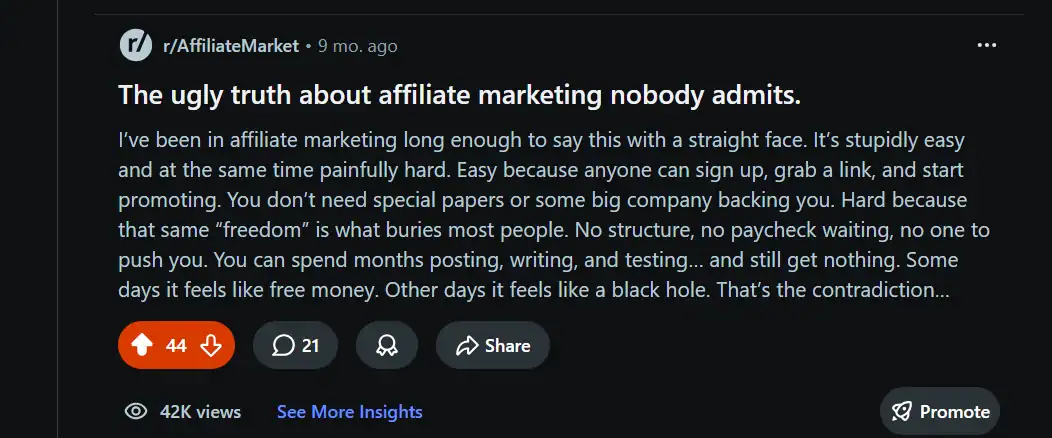
For example, the screenshot below shows one of my contributions in an affiliate marketing subreddit where I shared an honest opinion about the ugly truth nobody talks about in this space. The post received more than 40,000 views and over 40 upvotes because people could tell it came from real experience, not a sales pitch.
Facebook Groups in your niche operate similarly. Many groups allow promotional posts on specific days of the week or in designated threads. Understanding each group’s rules and respecting them is the foundation.
Quora is a question-and-answer platform where people ask specific questions across every topic imaginable. Well-written answers to questions in your niche can rank on Google themselves and bring in steady traffic over time.
Niche forums exist for specific topics — personal finance forums, blogging communities, digital marketing groups, health and wellness communities. These tend to have highly engaged audiences who are serious about the topic.
The Rules for Promoting in Communities Without Burning Trust
Give before you ask. Spend time in any community answering questions helpfully, sharing useful insights, and contributing genuinely before introducing anything promotional. Members notice who adds value and who just shows up to drop links.
Link to your content, not directly to affiliate links. Most communities allow links to blog posts or resources. Your blog post then contains the affiliate link in context. This approach is both more accepted by communities and more effective for conversions, because readers arrive at your recommendation with context rather than being sent straight to a product page.
Be transparent. If your content contains affiliate links, say so. Readers respect honesty and it keeps you on the right side of platform rules.
Prioritize the communities where your specific audience actually gathers. Being active in five relevant communities produces better results than spreading thin across twenty.
Method 6: Create and Share Content on Social Media
Organic social media is not the fastest affiliate traffic source. It requires consistency and a clear content strategy to produce results. But for beginners building an audience in a specific niche, it is a legitimate free channel worth investing in — particularly if you enjoy the platform you are building on.
The key principle is the same one that applies in communities. Social content that builds an audience and earns affiliate clicks is primarily educational and helpful, not promotional. The promotion is a small, natural part of an otherwise valuable content feed.
The Platform That Fits Your Niche
Not every platform suits every niche. Building on the wrong one means putting effort into an audience that does not align with your affiliate offers.
Instagram and TikTok work well for visual niches — fitness, food, travel, fashion, home decor, beauty. Short-form video performs particularly strongly in these spaces and can build an audience faster than almost any other organic method.
LinkedIn works well for professional, B2B, and career-oriented niches. If your affiliate offers are in the online business, SaaS, or productivity space, LinkedIn reaches a relevant audience that other platforms often do not.
Twitter, now X, works well for online business, technology, personal finance, and creator economy content. Short, useful posts in these niches accumulate engaged followers who are interested in tools and resources.
Pinterest, covered already in Method 3, stands alone as a search-engine-style platform and works particularly well for bloggers in visual niches.
The Content Formats That Drive the Most Affiliate Traffic
Educational carousel posts and short tutorial videos drive the most traffic from social media to affiliate content for most niches. These formats deliver enough value that people save them, share them, and follow the account for more.
The content that converts into affiliate clicks does not usually include the link in the post itself. It leads readers to your profile, your link-in-bio, or your blog content — where the recommendation and the link exist in a more complete context.
Social content creates awareness. Your blog, your email list, or your resources page closes the conversion. Thinking of social media as the top of the funnel rather than the conversion point changes how you approach it and dramatically improves your results.
Method 7: Leverage Free SEO Tools and Resources Pages
A resource page is one of the most underused free affiliate promotion tools available to bloggers and content creators. It is simple to create, requires no ongoing effort to maintain, and passively generates affiliate clicks for as long as your site gets traffic.
A resources page is a dedicated page on your blog or website that lists all the tools, platforms, courses, and services you use and recommend. Each item links to the relevant affiliate program. The page functions as a curated hub of everything useful in your niche.
What a Resources Page Looks Like
The most effective resources pages are organized by category rather than presented as a single long list. A resources page for a blogging and online income site might organize into sections like: blogging tools, email marketing, SEO tools, courses and education, and design tools.
Each item gets a brief description — one to three sentences explaining what the tool does, who it is best for, and why you recommend it. This is not a sales pitch. It is the same honest, helpful tone you use everywhere on your site.
This kind of page also builds trust. When a reader sees that you are transparent about what you use and why, it reinforces credibility across everything else on your site.
How to Drive Traffic to Your Resources Page
The resources page is not usually a post someone searches for directly. You drive traffic to it through two main methods.
Internal linking from your blog posts. When you mention a tool or resource in any post, link that mention to your resources page rather than directly to the affiliate link in every instance. Or do both — link the first mention to the affiliate directly and include a phrase like “I cover all the tools I use on my resources page here” with a link. This gives readers a natural path to explore your full set of recommendations.
Mentioning it in your email newsletters. Your subscribers are already your most engaged audience. Mentioning your resources page in a new subscriber welcome email or in regular newsletters keeps it visible to the people most likely to click and convert.
How to Promote Affiliate Links Without Ads — Choosing the Right Method for You
Seven methods are a lot to look at all at once. The practical question is where to start.
If you already have a blog or website, prioritize SEO-focused blog content and add a resources page. The infrastructure is already there. You just need to make sure your content is targeting the right keywords and your affiliate links are placed strategically within it.
If you have no website yet and want to start earning while you build one, communities and Quora are the fastest ways to drive early traffic. Use them to point readers to a simple landing page or a blog post on a free platform while you get your main site set up.
If you are comfortable on camera or creating video content, YouTube is worth prioritizing early because video content tends to build trust faster than written content, and the platform’s search engine gives you a realistic path to traffic without an existing audience.
If you want to build the most sustainable long-term affiliate income, combine a blog with an email list. Blogging brings in organic traffic. The email list captures and nurtures that traffic into a relationship that converts over time. Those two together are the foundation most successful affiliate marketers build on.
Whatever method you start with, go deep on it before adding another. A blogger who publishes consistently and builds their email list from the traffic will outperform someone who dabbles in all seven methods without mastering any of them.
The One Thing That Makes Every Free Method Work Better
You could apply every tactic in this guide correctly and still struggle with conversions if you miss this.
Trust.
Every free promotion method ultimately works because it allows you to demonstrate that you are genuinely trying to help your reader, not just earn a commission. The blog that gives honest reviews, including honest drawbacks. The email that delivers real value before mentioning a product. The community contributor who answers questions thoroughly without rushing to a promotion. The YouTube channel that covers the full picture of a tool before recommending it.
Trust is not a soft, unmeasurable concept in affiliate marketing. It is the difference between a 0.5 percent conversion rate and a 5 percent conversion rate on the same offer. The same product, recommended by someone the reader trusts versus someone they just encountered, converts at completely different rates.
Building that trust systematically — through a consistent voice, honest content, relevant recommendations, and a clear content structure — is what separates affiliate marketers who earn consistently from those who chase clicks and wonder why they never convert.
If you want to build your affiliate promotions around a proper system that earns trust and drives conversions from the first touchpoint to the final sale, that is exactly what THE H.E.A.R.T Funnel Formula was designed to do. It gives you a step-by-step framework for structuring your affiliate content and promotions around the kind of trust-based approach that works long-term.
Conclusion
Paid ads are not a prerequisite for affiliate income. Every method in this guide has produced real results for real affiliate marketers who started with no audience and no budget.
The seven free methods covered here: blogging, YouTube, Pinterest, email marketing, online communities, social media, and resources pages — all work on the same underlying principle. You create something genuinely useful, attract the right people to it, and introduce affiliate recommendations in a context where the reader already trusts you enough to act on them.
That cycle does not require money. It requires consistency, patience, and a genuine commitment to helping your audience before asking anything of them.
Pick one method that fits where you are right now. Build it seriously. Then layer in a second once the first is producing consistent results.
To go deeper on related strategies, read through how to start affiliate marketing for beginners or learn how to write blog posts that rank on Google. Both connect directly to the methods covered here and will strengthen whatever approach you choose to build on.
Frequently Asked Questions About How to Promote Affiliate Links Without Ads
Can I promote affiliate links for free without a website?
Yes. Communities like Reddit and Quora, social media platforms, YouTube, and Pinterest all allow you to share affiliate-related content without owning a website. That said, a website gives you the most control, the best SEO potential, and the cleanest path to building an email list. If budget is a genuine constraint right now, start with communities or a free platform and build toward a self-hosted site as your income grows.
Where is the best place to share affiliate links for free?
It depends on your niche and where your target audience spends time. A blog targeting Google search traffic through buyer-intent content is the most durable long-term option. For faster early results, active niche communities on Reddit, Facebook, or Quora let you reach people who are already asking questions your affiliate content answers. Email is the highest-converting channel once you have a list built.
Why are my affiliate links not getting any clicks?
The most common reasons are a mismatch between your content and your affiliate offer, too little traffic to the page where the links appear, no trust established before the recommendation, or poor placement of the link within the content. Check whether your content attracts people in buying mode, not just general information seekers. Review whether the affiliate offer is actually relevant to what the reader came to learn. And make sure the link is visible and mentioned explicitly, not just sitting quietly in a block of text.
How many affiliate links should I include in a blog post?
There is no perfect number. For a review post, one or two links to the same product makes sense. For a comparison or best-of post, a link to each recommended product is appropriate. For a how-to tutorial, one or two natural recommendations that fit the context are usually right. What matters more than quantity is relevance and placement. A single, well-placed, contextually relevant link outperforms five links dropped randomly into content that has not earned the reader’s trust.
How do I promote affiliate links on Pinterest without getting banned?
Pinterest allows affiliate links on pins in most cases, but the safest and most effective approach is to link pins to blog content rather than directly to affiliate offers. Your blog post then contains the affiliate link in context. This approach is more accepted by Pinterest’s policies, builds more trust with readers who arrive at your content first, and tends to convert at a higher rate. Always add a clear affiliate disclosure to your pin descriptions when affiliate links are involved.
How long does it take to make money promoting affiliate links for free?
It depends on the method and how consistently you apply it. Through online communities and Quora, you can earn your first commission within weeks if you answer the right questions in front of the right audience. Blog content typically takes three to six months to rank and generate consistent traffic. Email marketing converts well at any list size but takes time to build that list. Most beginners who follow a clear strategy and work consistently see their first affiliate commission within one to three months.