
What Is Affiliate Marketing and How It Works

What is affiliate marketing and how it works explained simply. Learn how beginners start, earn commissions, and grow online income.

What Is Affiliate Marketing?
Affiliate marketing is a way to earn money by promoting other people’s products and getting paid when someone buys through your link. You don’t own the product. You just connect the buyer to the seller and earn a commission.
In simple terms, you recommend something useful, share a special link, and get paid when it leads to a sale. That’s the whole model.
Most beginners think they need a big audience to start. That’s not the case. What matters more is trust and clear content. Even a small page can bring results if the message is right.
When I first looked into it, I assumed it was complex. It’s not. The process is simple, but results come from doing the basics well: picking the right product, explaining it clearly, and placing your link where it makes sense.
In fact, I’ve broken down exactly how to build that foundation in my H.E.A.R.T funnel formula book. It t walks you through the same approach I used to turn simple content into consistent commissions.
Learn more about the H.E.A.R.T funnel formula →
You’ll usually join an affiliate program, get your unique link, and then share it through content. This could be a blog post, a short video, or even a simple post answering a question people already search for.
The key is helping someone make a decision. If your content solves a problem or answers a question, people are more likely to click and take action.
Affiliate marketing works because businesses need customers, and you help bring them in. In return, they share a part of the sale with you.
It’s one of the easiest ways to start earning online because you don’t deal with products, shipping, or support. Your role is simple: connect the right product to the right person at the right time.
In this article, I’ll walk you through how affiliate marketing works step by step, so you can see how to start and turn it into real income.
How Affiliate Marketing Works (Simple Breakdown)
Affiliate marketing follows a simple flow. You join a program, get a link, share it, and earn when someone buys through it. Once you see it this way, it becomes easier to act on it.
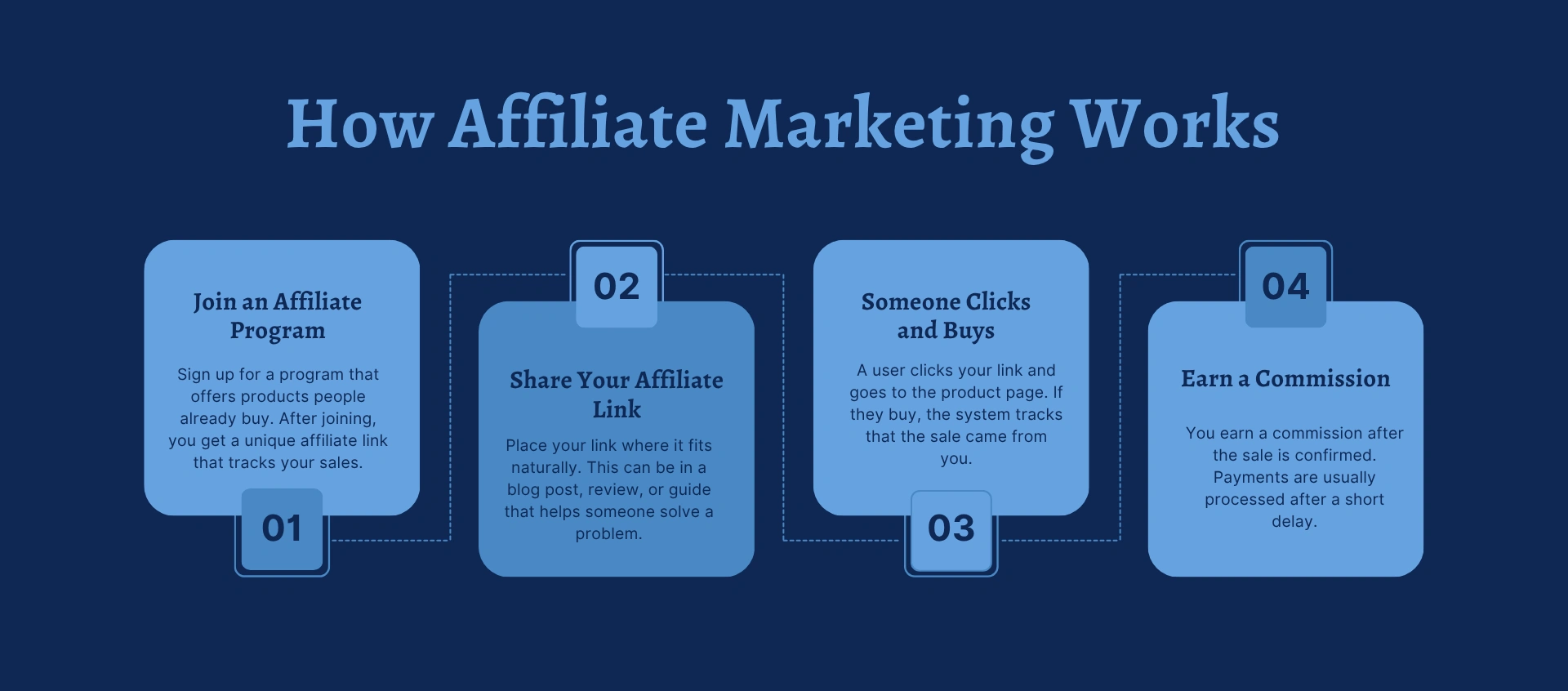
Step 1: You Join an Affiliate Program
You start by signing up for an affiliate program. This could be a company or a platform that offers products people already buy. After joining, you get a unique link often called an “affiliate link” that tracks any sales coming from you.
This link is what connects your effort to your earnings. Without it, nothing gets tracked.
Step 2: You Share Your Affiliate Link
Next, you place your link where people can see it without spamming. This could be inside a blog post, a product review, or a simple guide that answers a question.
The goal is not to drop links everywhere. It’s to place them where they make sense. If someone is already looking for a solution, your link becomes helpful, not pushy.
I found that simple content works best. A clear explanation or honest opinion does more than trying to “sell” too hard.
Step 3: Someone Clicks and Buys
When someone clicks your link, they are taken to the product page. If they decide to buy, the system tracks that the sale came from you.
Not everyone who clicks will buy. That’s normal. What matters is that your content attracts the right people, the ones already interested in what you’re sharing.
This is where trust plays a big role. People act when they feel the recommendation makes sense.
Step 4: You Earn a Commission
Once the purchase is completed, you earn a commission. The amount depends on the product and the program you joined.
You don’t get paid instantly in most cases. There’s usually a short delay while the sale is confirmed. After that, your earnings show up in your account.
Over time, as your content reaches more people, those small commissions start to add up. That’s how the process turns into a steady income.
Real Example of Affiliate Marketing
Sometimes the best way to understand something is to see it happen in real life. So let me walk you through a simple example.
Imagine you write a blog about home office setups. One day, you find a comfortable desk chair that helps with back pain. You’ve been using it for weeks and truly like it.
You join the chair company’s affiliate program. They approve you and give you your unique affiliate link.
Now you write a short post titled “The Desk Chair That Saved My Back (No More Pain).” In that post, you talk about why your old chair caused problems, how this new one helped, and what makes it different. Then you add your affiliate link so readers can check it out themselves.
A few days later, someone searches for “comfortable desk chair for back pain.” They find your post, read it, and trust your opinion because you shared a real experience.
They click your link, go to the product page, and buy the chair. The company tracks those sales back to your link. You just earned a commission.
That person gets a good chair. The company makes a sale. And you get paid for helping them connect. Everyone wins.
You didn’t answer customer emails. You didn’t pack or ship anything. You simply shared something useful, and the system handled the rest.
That’s affiliate marketing in action. Simple, honest, and effective.
Why Affiliate Marketing Is Popular for Beginners
Affiliate marketing has become a common starting point for online income, but not because it’s a “get rich quick” path. The real reasons are more practical. Here’s why so many beginners choose this model.
- You don’t need your own product – You simply promote what already exists instead of creating, stocking, or sourcing anything yourself.
- You can start with very little money – Most affiliate programs are free to join, and your main costs (like a simple website) can be kept low.
- You’re not responsible for customer support or shipping – The merchant handles all product questions, delivery issues, and returns after someone buys through your link.
- You can work at your own pace – Publish when you have time, and your content keeps working in the background for months.
- It scales quietly over time – One useful page brings small commissions; add more pages, and those small earnings slowly add up to something meaningful.
What You Need to Start Affiliate Marketing
Before you earn anything, you need a few basic pieces in place. None of them is complicated, but having them ready from the start will save you time and confusion later.
A Platform
You need somewhere to share your affiliate links. This is where your content lives and where people find your recommendations.
Common options include:
- A blog – Simple websites work best. You don’t need a complicated design. Just clear writing and helpful posts.
- Social media – Instagram, TikTok, Facebook, or X (formerly Twitter). You can post links in bios, stories, or posts depending on the platform’s rules.
- YouTube – Video reviews, tutorials, or “best of” lists work well. You place your links in the description box.
You don’t need all three. Pick one and learn how it works. A single platform done well is better than three done poorly.
A Niche
A niche is simply the topic you focus on. Instead of promoting everything, you stick to one area. This helps people trust you because they know what to expect.
Examples of niches:
- Home fitness equipment
- Dog training tools
- Budget travel gear
- Productivity apps
- Cooking gadgets
I recommend you narrow down your niche. Why narrow down? Because someone looking for coffee maker advice won’t care about your gaming chair recommendations. Staying focused makes your content more useful to the right audience.
If you’re unsure, pick something you already use or enjoy learning about. That makes writing or filming much easier.
Affiliate Programs
Affiliate programs are where you get your unique links. Each program represents a company or platform that pays commissions.
Some well-known options:
- Amazon Associates – Almost any product you can think of. Low commission but easy to start.
- ShareASale – A network with thousands of brands.
- ClickBank – Focuses on digital products like courses and software.
- Individual brand programs – Many companies run their own. Look for “affiliate program” at the bottom of their website.
You usually sign up, get approved, and then receive your link. Some programs approve everyone instantly. Others take a few days to review your application.
Start with one or two programs. More links won’t help if your content isn’t ready yet.
Basic Content Skills
You don’t need to be a professional writer or filmmaker. But you do need to communicate clearly.
Here’s what “basic skills” actually means:
- Writing – Can you explain why a product helped you? Can you list pros and cons without confusing the reader? That’s enough.
- Posting – Knowing how to upload an image, add a link, and hit publish. Platform dashboards are built to be simple.
- Simple video – Point your phone at the product. Talk naturally for two minutes. Upload it. No editing skills required.
You’ll improve as you go. The first post or video won’t be perfect, and that’s fine. What matters is starting and learning what works for your audience.
How Beginners Start Affiliate Marketing Step by Step
Let me walk you through the actual process. This is a simple path you can follow this week, even if you’re starting with no experience.
1. Choose a Niche You Understand
You don’t need to be the world’s top expert. You just need to know more than someone who knows nothing.
Think about what you already do or care about. Maybe you cook dinner every night, maybe you fix small things around the house, maybe you’ve tried three different phone stands and know which one actually works.
That’s enough.
Your niche doesn’t have to be unique. Plenty of people write about fitness, parenting, or gardening. What matters is that you can speak honestly about it. Beginners trust people who sound real, not people who sound like marketers.
If you’re stuck, ask yourself: “What have I bought or learned about recently that helped me?” That’s usually your answer.
Pick a Platform to Focus On
Most beginners try to do everything at once. They want to focus on a blog, YouTube, Instagram, and TikTok at the same time, all in the first month. That’s a fast path to burnout.
Pick one platform. Just one.
- Like writing? Start a simple blog. Free options exist, but a cheap domain and basic hosting work fine. As a beginner, I recommend starting with reliable hosting like Hostinger. It’s simple to set up, runs smoothly, and works well if you’re building your first site. You also get a free domain name for the first year, which helps you get started without extra cost.
- Like talking on camera? Start YouTube. Your phone is enough.
- Prefer short posts and images? Pick one social media channel and learn it.
You can add more later. But in the beginning, focus gives you momentum. One post a week on one platform beats five posts scattered across four places.
Join 1–2 Affiliate Programs
You don’t need a list of twenty programs. You need one or two that fit your niche.
If you’re reviewing kitchen tools, join Amazon Associates or a specific cookware brand’s program. If you’re talking about software, check if that tool has an affiliate program.
Apply. Get your link. That’s it.
Don’t chase high commissions at the start. Some programs pay 50%, but you’ll never sell that product because nobody’s searching for it. Start with products people actually buy. Low commissions on real sales are better than high commissions on nothing.
Create Helpful Content
Here’s what most beginners get wrong: they create content about the product instead of the problem.
Don’t write “Buy this blender.” Write “How to make smoothies that actually taste good.” Then mention that the blender helped.
Don’t film “Here’s my affiliate link.” Film “I tried three standing desks for a month. Here’s what I learned.”
Help first. Sell second. That shift changes everything.
Your first piece of content won’t be amazing. That’s fine. Publish it anyway. Then publish another. You get better by doing, not by planning.
Add Your Affiliate Links Naturally
Forced links feel desperate. Natural links feel helpful.
Read this sentence: “Click here to buy now.” Feels pushy, right?
Now read this: “After trying a few options, this is the one I stuck with. You can check the current price here.”
Same link. Different feel.
Only add a link when it answers a question someone probably has. If you’re explaining how to fix a leaky faucet, link to the wrench you used. If you’re sharing a recipe, link to the pan that made it easier.
If a page has ten links crammed in, people leave. If it has two or three useful ones, people click.
Less is more. Always.
How Do You Get Paid in Affiliate Marketing?

This is where a lot of beginners have questions. The short answer is: it depends on the program. But most follow a few common models.
Let me break them down so you know what to expect.
Commission Types
Not all affiliate programs pay the same way. Here are the three main structures you’ll come across.
Per Sale (Most Common)
You earn a percentage of the product price or a fixed amount when someone buys through your link.
Example: Let’s say you promote a $100 course with a 20% commission when someone buys it. You earn $20.
This is what most beginners will use. It’s straightforward. Someone buys, you get paid.
Per Lead
You earn money when someone signs up for something like a free trial, a newsletter, or an email list, even if they don’t buy anything yet.
Example: You promote a software company. Someone clicks your link and fills out a “start free trial” form. You earn a small fee, usually $2–$10 per lead.
This model is common for services like web hosting, insurance, or online tools.
Per Click (Rare for Beginners)
You earn a tiny amount each time someone clicks your link, regardless of whether they buy anything. These are usually called PPC (pay-per-click) programs.
Why rare? Because the pay is very low (often a few cents), and many programs no longer offer this model. Most beginners are better off focusing on per sale or per lead.
I recommend starting with per-sale programs. They’re the easiest to understand and the most widely available.
Payment Methods
When you finally earn money, how does it actually reach you? Most affiliate programs offer a few standard options.
- Bank transfer (wire) – Direct to your bank account. Common outside the US.
- PayPal – Fast and widely used. Many beginners prefer this.
- Check (cheque) – Mailed to your address. Slow but still offered by older programs.
- Gift cards or store credit – Some programs offer this instead of cash. Not ideal, but fine if you’d buy from that store anyway.
Before joining any program, check their payment methods. You don’t want to earn $200 only to realize they only pay by check and you live in a country where that’s difficult.
Basic Payout Timelines
You don’t get paid instantly after a sale. There’s almost always a waiting period. Here’s why and how long it usually takes.
The waiting period (30–60 days is normal)
Most programs have a return or refund window. If someone buys through your link but returns the product a week later, the company takes back your commission. To avoid paying you for refunded sales, they wait until that window closes.
Example: A 30-day refund policy means your commission isn’t confirmed until 30 days after the sale.
Minimum payout thresholds
Most programs won’t send money until you reach a minimum amount. Common thresholds are $50, $100, or even $500 for higher-tier programs.
If you earn $30 in a month but the minimum is $100, that $30 sits in your account until future earnings push you over the limit.
Typical payment schedule
Once your earnings clear the waiting period and meet the minimum, most programs pay once per month. Some pay twice a month. A few pay instantly to PayPal, but that’s less common.
Example timeline:
- January 15: Someone buys through your link.
- February 15: Refund window closes. Commission is confirmed.
- March 1: Payment is sent (if you’ve reached the minimum).
Yes, that feels slow. But this is standard across the industry. Once you have consistent sales, payments become regular and predictable.
Quick Summary Table
| What | Typical Range |
|---|---|
| Per sale commission | 5%–50% (commonly 10–20%) |
| Per lead fee | $2–$10 |
| Payment waiting period | 30–60 days |
| Minimum payout | $50–$100 |
| Payment frequency | Monthly |
How Much Can You Earn With Affiliate Marketing?
This is the question everyone wants answered. But most answers you’ll find online are either hype or completely vague. Let me give you something more useful: realistic expectations based on where you are in the process.
Set Honest Expectations First
Here’s the truth most people won’t tell you.
In your first few months, you might earn $0 to $100 total. Not per month. Total.
That sounds discouraging, but it shouldn’t be. Because the people who stick with it don’t stay at zero. The ones who quit are the ones who expected hundreds of dollars after three blog posts and no traffic.
Affiliate marketing is a slow build. Think of it like planting seeds. You write something useful today. Someone finds it three months from now. They buy something six months from now. That’s normal.
The people earning full-time incomes have been doing this for years or have existing audiences. That’s not a secret. That’s just how it works.
So set your expectations here: small, slow, and steady. Anything beyond that is a bonus.
Early Stage vs Growth Stage
Let me break down what earnings typically look like at different points. These are rough estimates based on common beginner experiences.
Early Stage (First 3–6 months)
- Monthly earnings: $0 – $200
- What’s happening: You’re learning. Your content count is low. Almost no one knows you exist yet.
- Goal: Not money. The goal is publishing consistently and figuring out what people actually click.
At this stage, a $20 commission feels like a win. Because it is. It proves the model works.
Growth Stage (6–12 months)
- Monthly earnings: $200 – $1,000
- What’s happening: You have 20–50 pieces of content. Some pages are getting regular visitors. A few links get clicked every week.
- Goal: Double what works. Write more about topics that have already brought sales. Stop wasting time on content that doesn’t.
This is where momentum starts. You’re not rich, but you’re seeing real money arrive each month.
Established Stage (1–2 years)
- Monthly earnings: $1,000 – $5,000+
- What’s happening: Consistent traffic. Multiple affiliate programs. Some pages rank well in search or your social following has grown.
- Goal: Scale what works. Outsource small tasks. Add new platforms.
Not everyone reaches this stage. But the ones who do are the ones who treated it like a long-term project, not a weekend experiment.
Depends on Traffic and Consistency
Two things determine your earnings more than anything else. Not your writing talent. Not your video quality. Just these two.
Traffic
No traffic, no clicks. No clicks, no sales.
You could have the best review ever written. If ten people see it, you might earn nothing. If ten thousand people see it, you’ll almost certainly earn something.
Traffic comes from:
- Search engines (Google, YouTube)
- Social media (followers, shares, hashtags)
- Links from other sites
- Email lists
Most beginners underestimate how long it takes to get traffic. It’s not about posting once. It’s about posting for months before anyone notices.
Consistency
This matters more than talent.
Someone who publishes one useful post every week for a year will almost always beat someone who publishes ten great posts in one month and then quits.
Affiliate marketing rewards patience. The math is simple: more content over more time equals more traffic equals more earnings.
There’s no secret trick. Just steady work.
A Realistic Monthly Breakdown Example
Let me give you a concrete example so you can see how small numbers add up.
Imagine you promote products with an average commission of $15 (common for many physical products on Amazon).
| Monthly clicks on your links | Conversion rate (buyers) | Sales | Earnings |
|---|---|---|---|
| 100 | 5% | 5 | $75 |
| 500 | 5% | 25 | $375 |
| 1,000 | 5% | 50 | $750 |
| 5,000 | 5% | 250 | $3,750 |
See what happened? You didn’t change anything except traffic. The conversion rate stayed the same.
That’s why beginners should focus less on “how do I get higher commissions” and more on “how do I get more relevant people to see my content.”
Quick Summary
| Stage | Typical Monthly Earnings | Main Focus |
|---|---|---|
| Early (0–6 months) | $0 – $200 | Publish consistently |
| Growth (6–12 months) | $200 – $1,000 | Double what works |
| Established (1–2 years) | $1,000 – $5,000+ | Scale and diversify |
Can you earn more than this? Yes, some people do. Can you earn less? Also yes, many people do. These numbers are just a realistic middle ground.
The truth: Affiliate marketing can pay well, but not quickly. If you’re okay with that, you have a real chance. If you need money next month, this probably isn’t the right path right now.
Simple Tips to Get Your First Affiliate Sale
Getting that first sale feels different from anything after it. It proves the system works.
Here are three simple, focused tips to help you cross that line.
Focus on One Product
Most beginners make the same mistake: they sign up for an affiliate program and immediately try to promote ten different products. That spreads your energy too thin.
Instead, pick one product. Just one.
Which product? Ask yourself these questions:
- Have I used it myself? (Personal experience makes content better.)
- Can I explain its benefits in two sentences?
- Would I recommend it to a friend without getting paid?
If you answer yes to all three, that’s your product.
Now put all your early effort into that single product. Write about it. Make a video about it. Answer questions about it. When you focus on one thing, your content gets deeper, not wider. And deeper content builds trust faster.
Once you get your first sale from that product, you can add a second. But not before.
Create Content Around Real Problems
Here’s what doesn’t work: “Buy this product. It’s great. Here’s my link.”
No one clicks that unless they already wanted to buy. And if they already wanted to buy, they don’t need you.
Here’s what does work: answering a real question someone already typed into Google or YouTube.
Examples:
- Instead of “Buy this blender” → “Why my smoothies were lumpy and how I fixed it”
- Instead of “Buy this backpack” → “What I wish I knew before buying a travel backpack”
- Instead of “Buy this software” → “How I stopped forgetting my passwords for good”
See the difference? The second example describes a problem. Someone searching for that problem doesn’t even know they need your product yet. Your content connects the problem to the solution.
That’s the magic. You’re not selling. You’re helping someone recognize what they actually need.
Action step: Think of one frustration or failure your product solves. Write a short post or film a 2-minute video titled with that problem. Then show how the product helped.
Use Clear Calls to Action
A call to action (CTA) is just a polite instruction telling someone what to do next. Many beginners forget to include one, or they make it confusing.
Bad CTAs:
- “Check this out, maybe if you want”
- “Link in bio or whatever”
- (No CTA at all)
Clear CTAs:
- “You can see the current price here.”
- “I’ve linked it below if you want to take a closer look.”
- “Click here to read more reviews on Amazon.”
Notice none of them shout “BUY NOW.” They’re calm. Helpful. Low pressure.
Where to place your CTA:
- At the end of a blog post after you’ve explained everything
- Naturally inside a tutorial when the product becomes relevant
- In your YouTube description with a short sentence like “The desk mat I use is linked below”
Don’t hide your link. But don’t scream at people either. A simple, clear sentence works best.
One more tip: Use “my” or “I” instead of “the.” Compare “the blender I use” vs “the blender.” Small word changes feel more personal and less like an ad.
Quick Checklist for Your First Sale
Before you publish anything, run through this list:
- I picked one product to focus on
- My content solves a real problem, not just “buy this”
- I included at least one clear, calm call to action
- My link works (test it yourself)
- I’m not trying to be perfect, just helpful
That’s it. Do these three things, and that first sale becomes a matter of when, not if.
Affiliate Marketing Mistakes to Avoid
You’ll learn a lot by doing. But a few mistakes are so common that it’s worth knowing them now. Avoid these, and you’ll save yourself weeks of wasted effort.
Promoting Too Many Products
New affiliates often sign up for every program they find. They stuff ten different links into one blog post or video. The thinking is: more products = more chances to earn.
It doesn’t work that way.
When you promote everything, you stand for nothing. Readers get confused. They don’t know what you actually recommend. And confused people don’t click.
The fix: Stick to one product at a time. Build content around it. Only add a second product after the first one has its own solid post or video.
Not Understanding the Product
Promoting something you’ve never used or barely understand is a fast way to lose trust. People can tell when you’re just reading a sales page out loud.
If someone asks a detailed question about the product and you can’t answer it, they won’t come back. Worse, they won’t click your links again.
The fix: Only promote products you’ve actually tried, or at least researched deeply. If you can’t explain three specific things you like about it, you’re not ready to recommend it.
Expecting Fast Results
This is the mistake that stops most beginners. They publish a few posts, wait a week, see no sales, and assume affiliate marketing doesn’t work.
But nothing happens quickly in this model. No traffic comes from nowhere. No one finds your content just because you hit publish. It takes weeks or months for search engines to notice you. It takes time to build an audience on social media.
Expecting fast results leads to quitting right before things could have started working.
The fix: Set a 6-month minimum before you judge your progress. Commit to publishing something every week for half a year. After that, look at your results. If you’ve been consistent, you’ll almost certainly see something happening.
Ignoring Your Audience
This one’s simple. If people leave comments or ask questions, answer them. If a product gets bad feedback, be honest about it. Trying to hide flaws or ignoring your readers kills trust fast.
The fix: Treat your audience like you’d treat a friend. Recommend what helps. Stay quiet about what doesn’t.
Is Affiliate Marketing Worth It?
Yes. But probably not for the reasons you think.
Let me answer this directly so you’re not left wondering.
Yes, affiliate marketing is worth it if you’re willing to treat it like a long-term project. No, it’s not worth it if you need money fast or want a passive income without doing the work.
That’s my honest truth.
What Makes It Worth It
- You can start with almost no money.
- You don’t need your own product, inventory, or customer support team.
- Once your content is published, it can keep earning for months or years.
- The skills you learn (writing, understanding people, basic marketing) are useful for almost anything online.
- You’re in control. No boss, no schedule, no permission needed.
For many people, that combination is hard to find anywhere else.
What Makes It Not Worth It
- The first few months can be slow and quiet. No sales. Very little traffic.
- You’ll put in hours before you see your first dollar.
- There’s no guarantee. Some niches are too competitive. Some products don’t sell.
- You have to be self-motivated. No one tells you what to do next.
- Results depend entirely on you showing up consistently, even when nothing seems to happen.
If any of those sound like dealbreakers, that’s fine. Better to know now.
Balance Expectation With Opportunity
Here’s how I think about it.
Affiliate marketing is not a lottery ticket. You won’t post one link and wake up rich.
But it’s also not a scam. Thousands of regular people earn real money this way. Not quit-your-job money for everyone, but real money.
The opportunity is this: you can build something small that grows into something meaningful over time. A few hundred dollars a month pays for groceries. A few thousand covers rent. And it can happen without you ever showing up to an office.
The expectation you should have is this: slow growth, steady learning, and small wins that add up.
If you can accept slow, you have a real chance. If you need fast, look elsewhere.
Who Should Try Affiliate Marketing?
You might be a good fit if:
- You’re patient and don’t panic when nothing happens for a while.
- You enjoy explaining things or helping people solve problems.
- You’re willing to learn as you go and improve over time.
- You don’t need immediate income from this.
You might want to skip it if:
- You need money in the next 30–60 days.
- You hate writing, recording, or posting anything online.
- You give up quickly when things feel slow.
NOTE: Affiliate marketing is simple but not easy. The model makes sense. The steps are clear. But doing them week after week, even when no one is watching, is what separates people who earn from people who quit.
If you’re ready for that, then yes, it’s absolutely worth it.
And if you start, you’ll learn something valuable no matter what: how to connect people with solutions. That skill alone is worth more than any single commission check.
Conclusion
Affiliate marketing isn’t magic. It’s not a hack. It’s a simple system that rewards patience, honesty, and consistency. You don’t need a big audience or a perfect website. You just need to help real people solve real problems, one piece of content at a time.
If you start, you’ll likely feel slow at first. That’s okay. Keep going. Publish another post. Answer another question. The first sale will come. And after that, the second gets easier.
Now you know what it is, how it works, and exactly what to do next. Whether you start today or think about it for another week, the path is clear whenever you’re ready.
If you want to go deeper, my H.E.A.R.T funnel formula book breaks down the exact structure I use to turn simple content into a system that keeps earning.
Check out the H.E.A.R.T funnel formula book →
Frequently Asked Questions
What is affiliate marketing in simple terms?
You recommend a product to someone. If they buy through your special link, you get paid a commission. You don’t own the product, ship it, or handle support. You just connect the buyer to the seller.
Think of it like telling a friend about a great restaurant. If they go because of you and the restaurant gives you a small “thank you,” that’s affiliate marketing.
How does affiliate marketing work for beginners?
You follow five basic steps:
Pick a topic you understand (like fitness, cooking, or productivity).
Choose one platform (a blog, YouTube, or social media).
Join one or two affiliate programs (Amazon Associates is a common start).
Create content that helps someone solve a problem.
Add your affiliate link naturally and share it.
That’s it. These steps, repeated over time, require no complex funnels or expensive tools.
Do I need money to start affiliate marketing?
Very little. Most affiliate programs are free to join. Your main costs might be:
A domain name and hosting for a blog ($5–$15 per month)
Nothing if you use free platforms like YouTube, Instagram, or Medium
You don’t need to buy ads. You don’t need inventory. You can start with zero dollars and only invest in hosting later if you choose to.
How do beginners get traffic?
Traffic means people finding your content. For most beginners, the two main sources are:
Search engines (Google, YouTube) – You write or film content that answers a question people are already searching for. Over weeks or months, search engines send visitors your way. This is slow but free and long-lasting.
Social media – You post your content on platforms like Pinterest, Instagram, TikTok, or Facebook. Some posts get seen by people who aren’t following you yet. This can be faster but less predictable.
The key is to pick one traffic source and learn it well before adding another.
How long does it take to make money in affiliate marketing?
Most beginners see their first sale within 3 to 6 months. Some get lucky in the first month. Others take 8 or 9 months. It depends on your niche, how often you publish, and whether you’re solving real problems.
Here’s a realistic timeline:
Month 1–3: Building content. Zero or very low traffic. Possibly no sales.
Month 4–6: Some traffic starts arriving. First sale possible.
Month 6–12: Consistent traffic. Regular small commissions.
The people who earn quickly usually have an existing audience (a popular Instagram page, a YouTube channel, etc.). For everyone else, patience is required.
The good news is that once content starts working, it can keep sending traffic and sales for months or years without extra work.